
Families recall 'amazing dedication' of Lancashire men in the Spanish Civil War as plaque unveiled at Unity Hall in Nelson
Relatives of local men who fought fascism in the 1930s Spanish Civil War attended the unveiling of a memorial plaque at a historic building in Nelson.
The town's Unity Hall features the new plaque unveiled by Coun Brian Newman, the Deputy Mayor of Pendle Borough Council.
This year is the 90th anniversary of the Spanish Civil War, which is often seen as the 'first battle of the Second World War'. It began after a coup by Spanish General Francisco Franco against Spain's democratic government. Franco was backed by Hitler’s Germany and Mussolini’s fascist Italy.
The British Government had a policy of non-intervention in Spain but critics disagreed, arguing fascism had be fought sooner rather than later. So volunteers travelled to Spain with the International Brigade, to fight alongside Spain's under-siege democratic government.
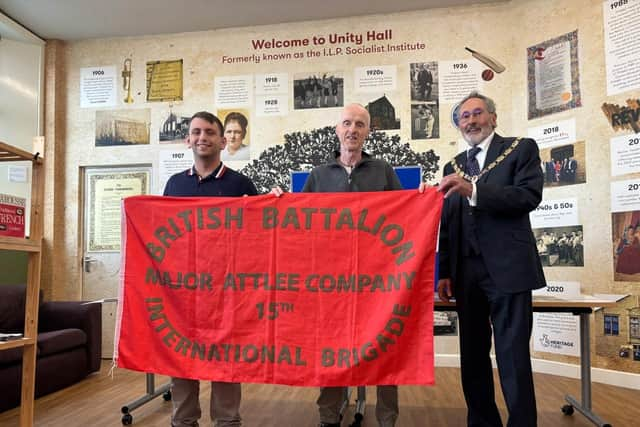

Volunteers from the Pendle area were James Bridge, George Buck and John Jolly, all from Nelson; Jack Howley from Colne and David Hartley King from Salterforth.
Relatives at the Nelson ceremony included Juanita Jolly and Verna Jolly, the daughters of John Jolly, who live in Haydock. And an exhibition at Unity Hall included letters sent from their dad while in Spain to their mum.
Juanita said: “Our dad was a lovely, gentle, good man. It's important to remember what he and others did to help Spain. Our mum (Edith Metcalfe), who was born in Brierfield, supported him and she as was also active in the Aid Spain movement in Lancashire and local politics.”
Verna added: “It's wonderful to see this plaque. The Spanish Civil War began 90 years ago, which seems like a long time. But there are similar issues today around the world, with the rise of extremism, so it's important to remember the democratic values these men fought for.”
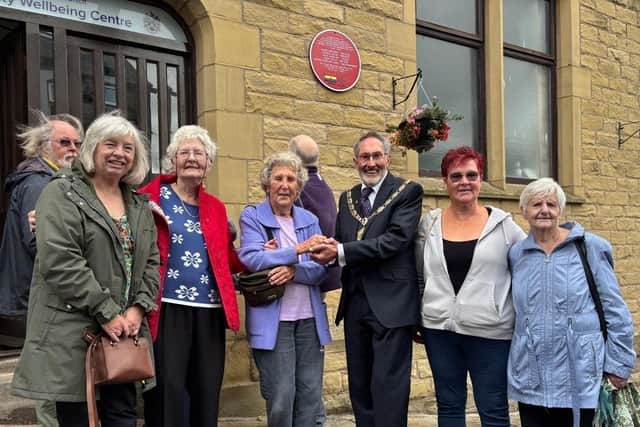
Also attending were Karen Deighton (nee Howley) and her brother, Alan Howley, both from Colne, who are relatives of Jack Howley.
Karen said: “The plaque is lovely to see and brings back lots of memories. I can remember Jack, who was quite a quiet man and his wife, Evelyn Howley, who was a hospital trustee in Colne.
“In Spain, Jack was taken prisoner but my aunts in Colne assumed he had died. However, they got a letter from him in prison. Eventually, he returned home and there was a party in Colne when he got back. He didn't talk much about the Spanish Civil War or the Second World war – but a lot of that generation didn't to say much about their experiences.”
Alan added: “It's really nice to see this plaque. It represents a big piece of history. It's important to commemorate the men and good to see such a strong turnout here. The International Brigade volunteers felt they were right to battle fascism in the 1930s. Jack and some others walked all the way to Southampton to catch a ship. They had amazing dedication.”
Other relatives there included Eileen Strickland and daughter Lynne, both from Morecambe, who have family links to David Hartley King. They too have contributed photos and family archive material to the project.
The Nelson ceremony also acknowledged other East Lancashire people who helped Spain in other ways, sending food and medical aid from towns including Nelson and Burnley. The Aid Spain movement included local committees, political parties, trade unions, mayors, councils and church people including Canon Hugh Dempsey of Trawden.
Visitors also had a chance to tour Unity Hall, which was was originally opened in 1908 by the Independent Labour Party (ILP). Today, it is home to a local archive and reading room, exhibitions on topics including the suffragettes and Selina Cooper, event spaces and Nelson Town Council.
Unity Hall supporters and trade union members have worked to get the plaque installed, supported by Burnley's branch of the Unite union. Speakers at the ceremony included Chris Keene, from North East Lancashire Trade Union Council and Peter Billington from Unite. Local unions have also supported a new International Brigade memorial in Burnley and hope to develop local memorials in Hyndburn and Rossendale.
Lewis Ashworth and Gary Webb, who help run Unity Hall's reading room, also spoke. Lewis, from Barrowford, studied history at university in Preston and researched Lancashire's Spanish Civil War links. Support has also come from the International Brigade Memorial Trust, which raises awareness of the Spanish Civil War and wants the era's significance taught in British schools.
Some of the Pendle men in Spain were linked to trade unions, the Independent Labour Party or the Communist Party, which was a key recruiter for the International Brigade. The ILP and its Clarion newspaper were significant influences in Lancashire, including Clarion choirs and cycling clubs. Nelson's Unity Hall is linked to the Clarion House outdoor centre at Newchurch, near Pendle Hill, which still operates today and is steeped in political history too.
The men
George Buck grew up in Colne then Nelson, where he was a metal moulder. He was also a Territorial Army reservist, the ceremony was told. In Spain, he served in a machine gun unit with distinction. He is associated with capturing an enemy fortified base, where a Franco flag was torn down as a trophy. The flag was brought back to Britain and presented to the Communist Party then the Labour Party and the Royal British Legion. Later in the Second World War, Buck served as a merchant seaman. After the war, he was active again in a metal moulders' trade union and became the Burnley branch secretary. He died, aged just 42, in 1958.
James Bridge, originally from Barnoldswick, worked in Derbyshire, Kelbrook and Nelson. In Spain, he was injured at the key Battle of Jarama while defending Madrid but recovered. He later told the Nelson Leader newspaper he was fighting 'to beat fascism in Spain and for decent homes for ordinary people in Britain'. He died in Burnley in 1981.
David Hartley King lived in Salterforth, Kelbrook and Nelson. He worked as a weaver then joined the Royal Marines for some time. He also lived in London, worked there as a mechanic and was active with the Aid Spain movement. In Spain, he served with an artillery unit where his mechanical knowledge was valuable.
Jack Howley served in the Aragon area but was captured by Franco's forces. He was sent to a brutal prison camp with other International Brigade prisoners. At one point, the prisoners were threatened with being shot by a machine gun. He was later released in autumn 1938 and returned home. A welcome party was held at Colne's Tower Ballroom.
John Jolly was born in Chorley but later lived in Brierfield and then Colne, working as a weaver. Earlier in life, he received the Distinguished Conduct Medal for gallantry with the East Lancashire Regiment in the First World War. He later lived in Haydock and died in 1981.