
Bygone Burnley: the Clarion movement of Burnley and Pendle, with historian Roger Frost MBE
Our Bygone Burnley episode today sees us explore the socialist Clarion movement that sprang up in Burnley and Pendle in the early 20th Century.
Respected local historian Roger Frost MBE takes us to several Clarion houses around North East Lancashire that were set up by the Independent Labour Movement to encourage working class people to escape the grime of industrial towns and enjoy the clean air of our wonderful countryside.
During our video tour we visit the newly-refurbished Clarion House, above Roughlee, which affords spectacular views across to Blacko and the surrounding area, and is believed to be the last of its kind anywhere in the world.
We also visit the Colne Clarion House, formerly the Farmer’s Arms above Trawden, and a former Clarion House of sorts at Robin House Lane, Briercliffe. Our video also makes reference to the Clarion House at Roggerham, Briercliffe.

Finally, we visit one of Nelson’s most historic buildings, Unity Hall Socialist Institute in Vernon Street, which was built by the Independent Labour Party in 1907.
We begin at Roughlee, though, and the wonderful Clarion House on the road to Barley.
Roger tells us: “This is the only Clarion House that exists anywhere in the country, possibly in the world. It is a very historic local spot. It holds pride of place as the one most well-known Clarion Houses.
“This was the third opened in Pendleside, in 1912, two years before the start of the First World War. It has recently been restored and has an orchard and children’s playing area.
“Originally, the people of this district and others wanted to get out of the smog and smoke of the industrial towns of Lancashire and Yorkshire. They would come by foot and railways, but particularly by bicycles.
“The first Clarion was founded by the National Clarion Cycling Club. Here at Roughlee we have beautiful countryside that lots of working people didn’t get any chance to see. The Labour Party and other socialist institutions all over the country worked hard to produce facilities like this.”
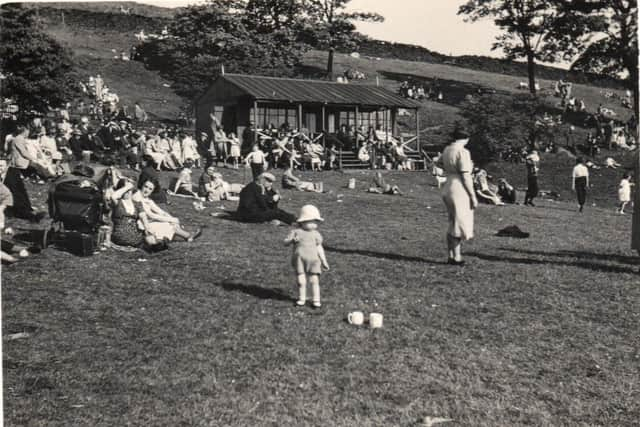
Roger next tells us about the cottage behind the Roggerham Gate Inn, at Briercliffe, which became a Clarion House. We have a wonderful photograph, reproduced here, showing a garden party at the Roggerham facility at the turn of the 20th Century.
Socialist meetings also took place in the nearby quarry which served as a natural ampitheatre.
However, it is chiefly associated with Tattersall Wilkinson, a self-educated antiquarian from Worsthorne, who lived in the Roggerham area for many years, and was known as ‘the sage of Roggerham’.
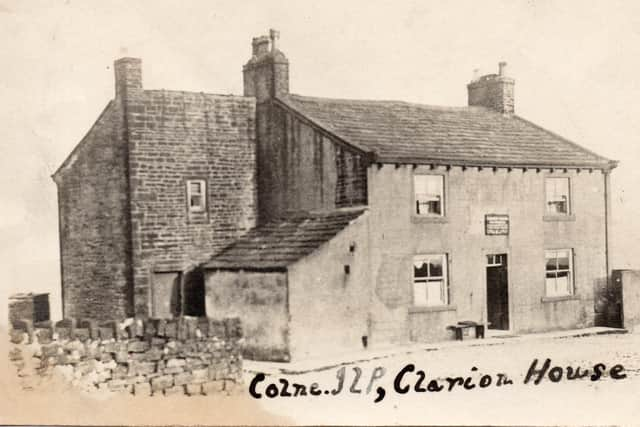
Next, we move to the remote Colne Clarion House above Trawden, originally the Farmer’s Arms. It had a piano room and served non-alcoholic refreshments and food in its Clarion days.
Robin House Lane in Briercliffe is our next port of call, and a row of cottages which housed in a former pub a Clarion of a kind, set up by the Socialist Democratic Federation. It welcomed cyclists and walkers, with accommodation.
“It was a different kind of Clarion”, according to Roger, and was never a cycling club. It affords a wonderful view of Pendle Hill, in keeping with all of the local Clarion Houses.
Finally, we visit the “centre of Nelson socialism”, Unity Hall, which was also involved with the Clarion movement.