
Bygone Burnley: Waddington, with historian Roger Frost MBE
Our Bygone Burnley episode this week takes us to the beautiful Ribble Valley village of Waddington.
The picture-postcard village located two miles north west of Clitheroe boasts a long and fascinating history that belies its small size.
Its quintissentially English appeal of blossoms, stream and country pubs has made it a popular destination in recent decades, but historian Roger Frost MBE sheds light on its dim and distant past for us.
We begin, fittingly, in the pretty little garden through which the Waddington Brook flows into the Ribble where Roger explains the etymology of Waddington.
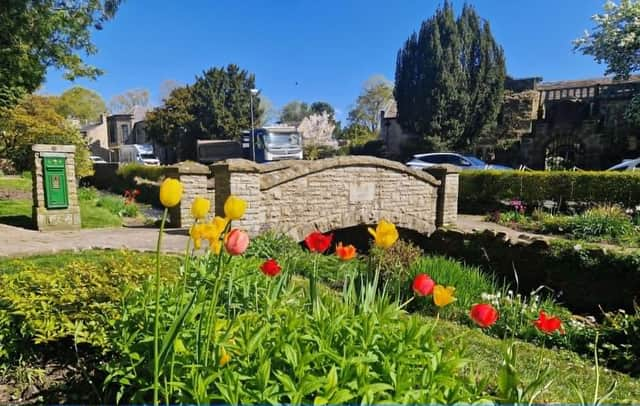

We also look at the village’s medieval stocks, adjacent pinfold, Waddington Hall, Almshouses and St Helen’s Church.
The name, of Anglo-Saxon origin, is believed to refer to a settlement (tun) of the tribe or people of Wada, a chieftain in the area.
Roger says: “Waddington Old Hall was the manor house in the past. In later years they built another outside the village. Wada was an Anglo-Saxon duke or dux, which did not mean a member of the titled nobility. It referred to an administrator.
“Wada also had lands in the Whitby area where he built a castle. In 798 AD after he’d been involved in a plot to assassinate the King of Northumbria, he was later defeated in a battle at nearby Billington. He survived the battle and later died near Whitby.”
The striking Waddington Almshouses are our next port of call. Founded in around 1700 by Robert Parker of Marley Hall, they stiill to this day provide affordable, independent housing for elderly women in the village.
A water pump with Parker’s initials and deer crest is still present on the lawn in front of the houses. Today, the charity is managed by a body of trustees and includes a community of single-storey cottages centered around a traditional village green.
"Robert Parker endowed these houses in 1700, originally for 12 widows of local dalesmen, and reconstituted in the 19th Century for around 29,” Roger tells us.
“The buildings are charming architecturally and still performing their original purpose. I think it’s a charming feature of Waddington that has so many institutions that have survived the centuries.”
Another suriving feature are the stocks, used for minor punishments for indiscretions.
Roger finally takes us to St Helen’s Church, which he describes as one of his favourites.
“There are a few problems with St Helen’s Church. It looks to be an old English country church but in actual fact it’s not. The first reference are to the 13th Century or earlier when there was a chapel here. It was not a parish church until much later.
“What we do know is that the oldest part of the present building is the tower which dates from around 1501 to 1511. It replaced an earlier tower that was demolished in the 15th Century. The nave, however, is only 120 years old. It looks much older because when the church was rebuilt at the end of the 19th Century the congregation decided to restore the nave and the chancel to reflect the one which existed before.”