
Bygone Burnley: Brierfield, with historian Roger Frost MBE
Our Bygone Burnley episode this week takes us to Brierfield and the home of what was once “one of the largest integrated cotton mills in the world.”
Historian Roger Frost MBE guides us around Brierfield, located between Burnley and Nelson, shedding light on some fascinating facts about the area.
We begin our journey outside what is now known as Northlight, but was once Brierfield Mills, a gigantic cotton spinning and weaving operation on the banks of the Leeds Liverpool Canal.
Roger says: “Brierfield Mills was owned by a Burnley firm called Tunstills who started building it in the 1860s. This magnificent mill was at one time the biggest integrated cotton weaving and spinning mill in the world.

“It contains all the branches of spinning and weaving, although it did not do calico printing, bleaching or dyeing, but did the main textile processes for which this area was famous.”
Indeed, this “gigantic” landmark covered nearly 400,000 square feet, and by the 1940s operated as a major integrated site with over 90,000 spindles and 2,800 looms in its prime.
The mill later pivoted to produce surgical bandages for Smith and Nephew before closing in 2007. It has now been transformed into a mixed-use destination known as Northlight featuring residential, leisure and business units.
We next head to St Luke’s Church, which has lots of connections to Burnley. Opened in 1872, the principal benefactor was a Burnley man, the Rev. William Thursby, who built St John’s parish church in Worsthorne.

Roger added: “The church was opened by General Scarlett, who had lots of connections to Burnley. On top of that the architect was a Burley man too, James Green, who lived in Portsmouth, Cliviger. He designed several important buildings in Burnley, including the Mechanics Institute and the old Victorian market hall.”
Roger goes on to reveal that another big connection between Burnley and Brierfield is that of transport.
“Brierfield has a very interesting transport history,” he added. “The road that goes through Brierfield and onto Nelson and Colne is an ancient route, which goes back to the very early Medieval times. However, some are more recent – particularly the big turnpike road that connected Liverpool to Hull.
“People don’t realise how important this was, as it linked the Irish Sea to the North Sea long before the canal was built.”
Speaking of canals, the Leeds and Liverpool Canal, which flows directly past Brierfield Mills, became an important waterway in Victorian times.”
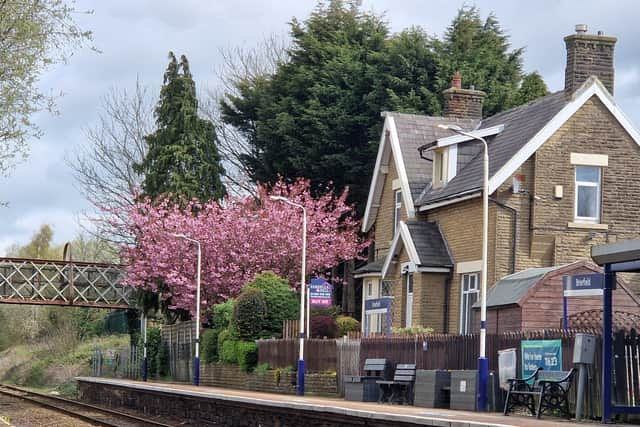
However, perhaps the most consequential transport innovation for Briefield was that of the railways, so much so in fact that it actually created the new names for the town and that of neighbouring Nelson.
Roger explains: “In the 1840s the railways came and this is an interesting thing about Brierfield because when the railways were under construction there was no such place as Brierfield, it was known as ‘Little Marsden’.
“The Lancashire and Yorkshire Railway Company already had a Marsden station near Huddersfield. So when they came to Brierfield and Nelson they found that they were Little and Great Marsden. They didn’t want another Marsden on their timetable so they renamed their station after the Nelson Hotel, making it the only town in England named after a pub.
“In Brierfield the name came from a plot of land, the brier field.”