
Bygone Burnley: Haggate, with historian Roger Frost MBE
Our latest Bygone Burnley episode explores the village of Haggate, which dates to the 16th Century.
Local historian Roger Frost MBE, a native of Briercliffe, in which Haggate is located, guides us around this pleasant locale and regales us with tales of civil war skirmishes, Victorian personalities and one of Burnley’s oldest pubs.
We begin our video guide, though, in the cemetery of Haggate Baptist Church and the final resting place of a Victorian entrepreneur and ‘celebrity’ whose name is still a familar sight on our high streets today – Abraham Altham – the founder of what became Altham’s Travel company.
It is also the resting place of famous musician Jeremiah Preston who produced large oratorio events at places like Turf Moor to raise money for the new Victoria Hospital in Burnley.
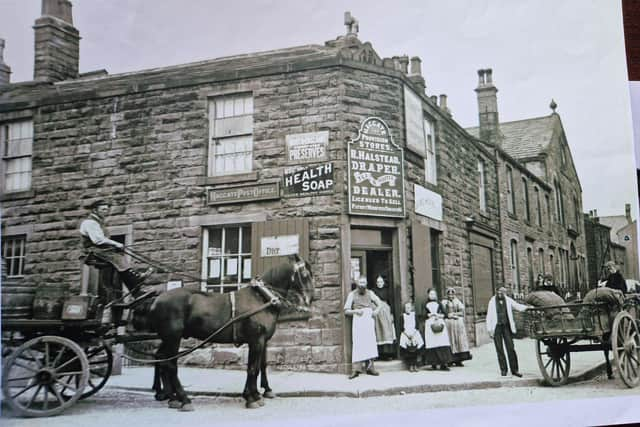

He also wrote about his childhood growing up in Briercliffe in the days of the handloom weavers.
Abraham Altham, who built Oakleigh, now the Oaks Hotel in Reedley, was only 44 when he died. However, he had established the biggest chain of grocery shops in England, Roger describing him as “the Tesco of his day”. His father was the school master in Haggate.
The graveyard has existed since the 18th Century, but the oldest building in the village is the Hare and Hounds pub, which is reputed to have been built in 1585, Roger tells us.
“By the 17th Century Haggate was a hamlet. In the 18th Century the chapel was built. The current cemetery was built in 1865,” he added.
We next move behind the Hare and Hounds and the fantastic panoramic views of Boulsworth, the Thursden Valley, Extwistle Moor and Extwistle Hill.
From this viewpoint, you can also see the site of a civil war skirmish that took place on June 24th, 1644. A prelude to the Battle of Marston Moor, the skirmish saw five Parliamentarians killed by the forces of the Royalist, Sir Charles Lucas.
Roger explained: “In 1644 Prince Rupert of the Rhine had been ordered by King Charles I to relieve the royal forces that were penned in at York by three Parliamentary armies. Prince Rupert was in Lancashire at Latham near Liverpool at the time, having had a successful campaign.
“Rupert decided to gather his forces, about 14,000 men, and march to York. When he got into East Lancashire he divided his forces into three units, one of which came through Padiham, Burnley and Haggate and intended to march to Thursden and along the Long Causeway to Heptonstall. However, when they reached Briercliffe some Parliamentary soldiers met them, and a skirmish ensued which led to the death of five Parliamentary soliders.
“All the wounded men were brought to the Hare and Hounds. The five that died were all local men and were buried at St Peter’s Church graveyard.”
Despite this very minor local success for the Royalist cause, the King’s forces, led by Prince Rupert, were defeated at Marston Moor several days later on July 2nd.
Roger next tells us about another prominent building in the village, the reading rooms built in 1887. Our story ends with a look at handloom weavers’ cottages, dating from around 1815.