
Bygone Burnley: Slaidburn, with historian Roger Frost MBE
Our Bygone episode today takes us to the charming Ribble Valley village of Slaidburn.
Nestled in the Forest of Bowland, and historically part of the West Riding of Yorkshire, Slaidburn has a long history and retains many notable historic buildings.
Local historian Roger Frost MBE takes us to some of these sites and reveals some of the fascinating stories behind them.
Our story begins at the 15th Century St Andrew’s Church in the village, an impressive Grade I-listed building built in the perpendicular style.

Roger said: “Slaidburn has a long history, it’s mentioned in the Domesday Book. The name means ‘a low-lying sheep meadow’ and the churchyard is part of that. It probably fully means ‘by the stream’, which is the Hodder. It starts just above Slaidburn and is joined in the village by the Croasdale.”
Roger points out three important graves which lie directly below the church tower, those of three members of the prominent Peel family, relatives of the famous British Prime Minister Sir Robert Peel.
We next step inside the church where Roger highlights a superb stained-glass window behind the altar and an impressive example of a three-decker pulpit.
However, he first reveals the relevance of the church’s name, that of the patron saint of Scotland.
“In the north of England there are lots of churches dedicated to St Andrew. The north of England was often invaded by the Scots, coming as far down as Clitheroe, as we’ve mentioned in a previous episode of this series.
"People realised that if the church was dedicated to St Andrew the Scots would be less likely to destroy it. The interior is very special. It’s largely unaltered from the 17th Century.
“The magnificent east window, whilst not particularly old, has wonderful colouring featuring the story of the Nativity and has a shooting star of Bethlehem.
“Another notable feature in the church is its three-decker pulpit. These were very common in the days when there were lots of tall pews. The clergyman would give his sermon from the top while a clerk would sit below. There are very few left now.”
Outside the church, we look at the architecture of the building and its dominant tower.
“St Andrew’s is justifiably a Grade I-listed building,” Roger added. “Built in the perpendicular style, but unlike some, the whole of the nave and chancel are at the same height. It followed the period of Gothic architecture.”
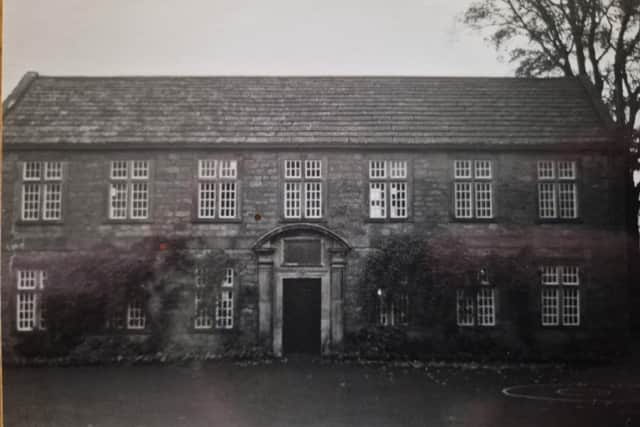
Next to the churchyard sits another fascinating old building, which we explore next – the Brennand’s School, founded in 1717 as a grammar school for local boys, now the village primary school. Brennand was a farmer landowner who left money for the school in his will.
Finally, we look at the sadly now-closed village pub, the Hark to Bounty, which had an important role in the history of the village, being the site of a halmot or manorial court for the surrounding area.
This determined what punishments there should be for small crimes, but also looked at disputes between farmers and landowners.