
Reform UK will be 'denied wins' in these parts of Lancashire if local elections cancelled, party claims
Reform UK has claimed it would get the most votes in two of the local elections that could be cancelled in Lancashire this year – and come second in two of the others.
Polling carried out on behalf of the party suggests it would secure the largest shares of the vote in the Chorley and Hyndburn council areas and be the runner up by that measure in Preston and Blackburn with Darwen. All of the authorities are currently held by Labour.
Reform’s prediction does not indicate how the suggested vote shares would translate into the number of actual seats won, as it was not possible to model that outcome, the party told the Local Democracy Reporting Service (LDRS).
The four authorities are amongst seven in the county – the others being coalition-controlled Burnley and Pendle, and Labour-led West Lancashire – where votes are scheduled to be staged in May.
As only a third of the seats are up for grabs in each case, it would not be possible for Reform to secure an outright majority on any of the councils, since it currently holds only one seat on Preston, Chorley and Pendle, two on Burnley and none on Blackburn with Darwen, Hyndburn and West Lancashire.
However, party leader Nigel Farage says “the establishment” is seeking to scrap the council contests, because “they know Reform would win them”.
He added: “Denying elections is the disgraceful behaviour of a banana republic. Reform UK has launched a judicial review against this abuse of power by the government.”
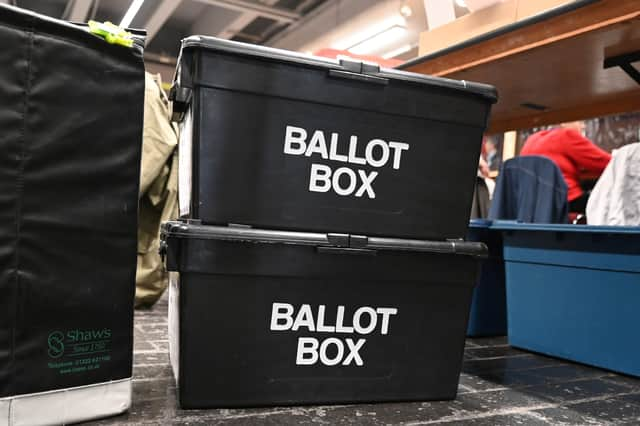

The research into voting intention was conducted by polling company JL Partners which says it used a “representative” and “weighted” sample of 4,441 adults across 25 local authority areas where the elections are in doubt.
The study also found 82 percent of those questioned believed the votes should go ahead, compared to five percent who did not – with the remainder being “unsure”.
The government invited the 63 English councils with elections due this year – and which are also set to be abolished in 2028 as a result of a shake-up ordered by ministers – the chance to request what they described as the “postponement” of the planned polls.
It said it would listen to any concerns about the capacity to deliver them alongside the major local government reorganisation (LGR) process that is poised to start in earnest in more than 20 parts of England in the coming months.
The leaders of all seven Lancashire authorities that fulfill the government’s criteria have made postponement requests – six of them on the basis of majority or unanimous votes of their cabinets and full councils, while West Lancashire’s leader has done so only in her capacity as Labour group leader, because the authority itself has not voted on the issue. There have been varying degrees of local political controversy in each case.
Regardless of the government’s ultimate decision, which is expected imminently, elections to so-called ‘shadow’ versions of the replacement councils for Lancashire – the size and shape of which will be decided by the government later this year – will be held in May 2027, ahead of them formally coming into being on 1st April, 2028.
The LDRS approached the leaders of the four Lancashire councils in areas where Reform had commissioned polling. Only Preston City Council’s leader had responded by the time of publication.
Commenting on the forecast for Preston, which suggested Reform would take 24 percent of the vote in May, compared to 26 percent, the largest share, for Labour, the city’s leader, Matthew Brown, said: “I am pleased to see Reform’s support continue to fall across Preston – a trend we are also seeing in national opinion polls, as the public are realising they have become a home for right-wing Tories who spent their career attacking the interests of working people here in Preston and beyond.
“We have made our views clear about the need to postpone elections this year to ensure we successfully deliver the biggest changes in local government for over 50 years in Preston – a process Reform in Lancashire wish to delay by arguing themselves for the postponement of elections for these new councils beyond next year, alongside postponing the key contest for an elected mayor of Lancashire.”
It would be mathematically impossible for Labour to lose control of Chorley Council to any party in May, such is its current dominance at the town hall, with 37 out of 42 seats. Nevertheless, the Reform polling suggested it would be Reform itself that came out on top in terms of vote share, scooping 32 percent, ahead of Labour on 24 percent.
Chorley leader Alistair Bradley has previously defended requesting that the plug be pulled on the scheduled polls. He told the LDRS last month that holding elections this year could derail the LGR process.
“Elections in the middle of [LGR] will just create more delay. We’re better off focusing on where we need to go than where we are now, because our residents are crying out for more efficient local government.
“We don’t want to cancel elections – it’s democracy and, as politicians, that’s what we’re about.
“But we want to do what’s best for the public of Chorley and, in our view, that is not to hold elections before a major change, but to hold them after we know what that change is going to be,” Cllr Bradley said.
In Blackburn with Darwen, the Reform polling pointed towards the party getting 24 percent of the vote share, behind Labour on 29 percent.
Speaking just before Christmas, council leader Phil Riley told the LDRS that as well as planning for the redrawing of the local authority map in Lancashire, councils also had to “continue delivering local services – so we are absolutely not short of things to do”.
“Having elections for a body which is going to disappear is, in my view, unnecessary,” he added.
The Reform-commissioned research in Hyndburn predicted a vote share victory for the party of 32 percent, compared to Labour on 28 percent.
In December, borough council leader Munsif Dad said: “Holding elections during a major reorganisation would result in short-term appointments, additional taxpayer costs and increased pressure on council resources – at a time when the priority must be a smooth transition. Postponement would reduce disruption and support the effective establishment of the shadow [replacement] authority.”
The Reform UK leader of Lancashire County Council – which is not one of the authorities where elections are due in May – last week wrote to the government to set out County Hall’s “strong view that these elections should not be cancelled”. The authority backed, by a majority, a motion on the subject back in November.
In the letter, seen by the LDRS, county council leader Stephen Atkinson rubbishes the suggestion that local authorities cannot both prepare for reorganisation and stage elections, stating there is “no reason” they cannot proceed as planned.
“Lancashire councils have the experience, systems and resources to deliver elections effectively alongside other statutory responsibilities, as has always been the case. Officers are well-practiced in managing complex processes and can ensure elections are conducted smoothly without compromising other priorities.
“Activities [in relation to LGR] in the coming months will focus on the areas that can be advanced without a government decision on the preferred proposal, which is not expected until the Summer – after the May 2026 local elections. Whilst activities will inevitably start to intensify as the year progresses, much of the initial work sits with senior officers. Crucially, this is broadly a different set of officers to those [who] would prepare and deliver local elections.
“Democracy is precious and must be protected, particularly during times of change. The right of residents to choose their representatives is fundamental to public trust and accountability. Suspending elections risks undermining confidence in local governance and sends the wrong message about the value we place on democratic principles,” County Cllr Atkinson added.
Prior to last week’s deadline for submissions to the government from councils, a spokesperson for the Ministry of Housing, Communities and Local Government told the LDRS: “We will not govern from Whitehall without the consent of local government.
“That is why we are asking each local authority which is undergoing local government reorganisation whether they would want to delay elections in these extraordinary circumstances.
“The view of local government leaders will be taken seriously and we hope to make a more informed decision.”
Lancashire County Council, then under Conservative control, had the opportunity early last year to request cancellation of the May 2025 local elections, but declined to do so – and the Tories were subsequently ousted by the current Reform UK administration.
Both the current and previous Conservative governments have delayed elections in other parts of the country when LGR has been taking place.