
SSB Law collapse: SRA failed to protect vulnerable people hit with crippling debts, review reveals
England’s regulator of solicitors failed to protect vulnerable people hit with crippling, unexpected debts, an independent review reveals - prompting Burnley campaigners to call for greater accountability.
The Solicitors Regulation Authority has apologised and fully accepted all the recommendations of an investigation into how it handled complaints about legal firm SSB Law.
Numerous residents are facing devastating legal costs due to SSB’s poor management of no-win, no-fee cavity wall insulation claims.
The firm went bust in January 2024 with debts exceeding £200m that had mostly arisen from third-party litigation loans.


The SRA failed to respond sufficiently to more than 100 complaints made about SSB between January 2019 and March 2024, according to a report commissioned by the Legal Services Board. This allowed SSB “to cause further harm to its clients.”
The LSB, England and Wales’ oversight regulator for legal services, is publicly condemning the SRA’s inaction, issuing it performance targets, and urging it to change its complaints procedures.
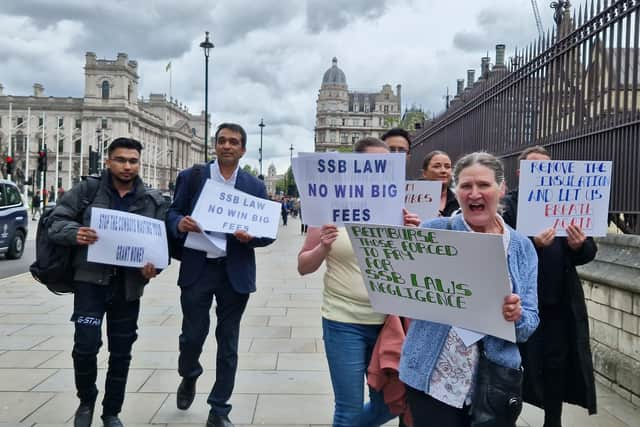
However, the SSB Law Victims Support Group argues that current measures fail to deliver genuine justice or real accountability for regulatory failures.
Group spokesperson Debra Sofia Magdalene said: “The LSB’s censure of the SRA is a formal warning, not real accountability.

“It recognises failure but doesn’t repair the damage or deliver justice for victims. Thousands of families have suffered because regulators acted too slowly.
“What’s needed now is genuine reform, faster intervention, and independent oversight to make sure promises of change are kept.”
We have spoken with hundreds of victims, including single mums, pensioners, and those with a chronic illness, limited English, and low incomes. Many describe having sleepless nights or living in fear of the bailiffs after amassing huge debts.
This is despite being assured throughout their claim that they wouldn’t pay anything, as ATE insurance was supposedly in place should their case fail.
Allegations against SSB include:
- Obtaining CWI clients via claims management companies.
- Acting without adequate instructions from clients.
- Issuing meritless claims and having inadequate evidence of damage caused by CWI.
- A lack of proper due diligence.
- Inflating damages.
- Using unreliable expert evidence.
- Instructing experts who were not independent.
- Progressing cases too slowly, missing key court deadlines, and clients being unrepresented at court.
- Failing to pay court fees.
- Poor communication with clients.
- Lack of supervision of SSB employees acting on CWI cases.
- Failing to properly advise clients about their entitlement to claim on their CWI guarantee and the financial risks of “no-win no-fee” and of discontinuing claims.
- Failing to ensure adequate insurance cover was in place to cover clients’ potential liability for defence costs.
- Breaching the terms of clients’ insurance policies, which resulted in clients becoming liable to pay defence costs.
- Financial mismanagement.
The Burnley Express and SSB Law Victims Support Group presented evidence of consumer harm to the LSB during its investigation.
Among those impacted is Burnley mum, Sharon Lord, who was hit with a £17,000 bill.
Sharon said: “The whole situation with SSB has been a continuous nightmare from start to finish. Even now, thinking about them sends my anxiety through the roof, and I’ll never truly trust the justice system again.
“The SRA knew SSB weren’t practicing correctly and chose to do nothing.
“Hopefully, the next steps will ensure that not only solicitors but also the SRA will never be allowed to do this again.”
Sharon says she feels “relieved that the situation has finally been recognised and that protection will be there for others,” but that it’s “too little too late for those of us who have been going through this for two years or more.
“Both SSB solicitors and the SRA seem to have gotten off lightly.
“The amount of work we’ve had to do to get this recognised is well outside the boundaries of what it should have been. It took hundreds of us putting in formal complaints to even get this investigated.”
Anna Bradley, SRA chair, said: “We are sorry that we did not act more quickly in relation to SSB, and that the issues in our handling contributed to the harm and distress suffered by the many vulnerable consumers affected.”
She added that the regulator is “committed to doing all we can to learn from this event and to implement its recommendations. “The case showed that we need to continue changing the way we spot and assess risk and use data so that we can proactively identify new and emerging risks and threats and act on them before consumers suffer.
“We were keen to get on with addressing these issues ahead of the publication of this review, so we have already made significant changes to the way we work since 2024. We will now build on this, addressing any additional areas for improvement outlined.”
In February, the SRA indefinitely banned four solicitors - Jeremy Brooke, Lucy Helen Flynn, David Neil Toyn, and Debra Jane Allen - from managing no-win, no-fee claims.
The regulator is investigating problems with the wider high-volume consumer claims market, which includes housing disrepair, data breaches, flight delays, diesel car emissions, and motor finance commissions.
It is also probing more than 70 law firms and has closed five, and expects more than 700 other companies to complete a mandatory declaration of compliance.
The victims’ group welcomed the regulator’s apology and thanked the LSB for its investigation.
Catherine Brown, LSB’s Interim Chair, said: “The action we are initiating reflects the scale of the human impact and the importance of holding regulators to account.
“I would like to thank the SSB Victim’s Group for sharing their experiences with us and Carson McDowell [who conducted the review].”
Catherine urged the SRA to “sharpen” its assessment of complaints before acting quickly and decisively when action is clearly needed.
The victims’ group, however, is also calling for:
1. A comprehensive redress plan, not just signposting between regulators;
2. Clear accountability for individuals and institutions that profited from these failed schemes;
3. A cross-agency review into systemic weaknesses across the legal and financial oversight framework.