
Bygone Burnley, with historian Roger Frost MBE: Manchester Road, Glen View Road and Rossendale Road
Roger Frost MBE delves into Manchester Road's industrial and social history, revealing an intersection with a 'mixed' past of grand homes and industry
Continuing our theme of major Burnley road junctions, this week’s Bygone Burnley episode sees local historian Roger Frost MBE explore the intersection of Manchester Road, Glen View Road and Rossendale Road.
Located in the south of Burnley, this busy road junction sits in a pleasant area of town where many late Victorian industrialists made their homes in grand buildings, particularly on Manchester Road and Glen View Road.
It is a story not just of homes, but also industry, particularly along Rossendale Road, which even today is adding to that sector.
But it is a particular row of homes in Rossendale Road that Roger first draws our attention to, indeed the southern side of the road which is actually in the old parish of Habergham Eaves rather than Burnley.
He reveals that during the Second World War a mock, dummy airfield was constructed nearby, which resulted in a bomb being dropped by the German Luftwaffe, which hit the row near the top of Rossendale Road.
A Burnley Express photographer captured the scene, but the government refused to allow its publication at the time.
Roger next goes on to explore more of the industrial side of Rossendale Road, particularly its origins in the 1950s.
He said: “Rossendale Road is very different to Manchester and Glen View Roads,” Roger explains. Burnley received funding in the 1950s to create an enterprise zone in Rossendale Road, an area where factories came from all over the country.
“VEKA and AMS Neve are two significant businesses based here.”
Returning to Manchester Road we look at two landmark properties including the ‘castle’ - a domestic home resembling a medieval keep, which was once owned by Burnley’s principal medical officer Dr Luke Collins.
Its nickname actually stuck when trams, which used to turn around outside the house, began to bear the destination sign of ‘The Castle’.
Actually dating to the Edwardian-era, the house was built in 1909 by renowned architect Edgar Wood.
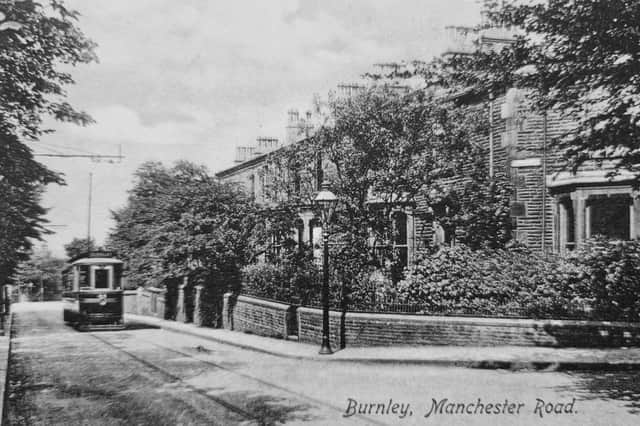

The other significant property in the locality is Rosehill House, where the family that owned some of Burnley’s biggest cotton mills lived.
Two significant industrial locations - Apex garage and Oswald Tillotsons, which had a huge cotton mill, were located at the top end of Manchester Road, the route to Rawtenstall and eventually Manchester.
When cotton was king, many Burnley cotton manufacturers had to attend the Manchester markets held at the Exchange. However, surprisingly, Manchester Road was not the route they took.
The original route was Coal Clough Lane and Cog Lane, which used to come right up to Manchester Road where it joined near the former Bull and Butcher pub, now the site of a nursing home.
Roger ends by explaining how Burnley has always had “mixed” locations of domestic and industrial interests.
“Burnley is a very mixed town and always has been and hopefully always will be.”