
Bygone Burnley: Barley, with historian Roger Frost MBE
Our Bygone Burnley video series today sees us travel out to the charming village of Barley, perched delicately under the shadow of the striking Pendle Hill.
Barley’s proximity to our famous natural landmark will forever see it tied in people’s minds to the hill and its association with the legendary Lancashire Witch Trials of 1612, but local historian Roger Frost MBE tells us there is much more to the village.
Like many small settlements in north-east Lancashire, Barley began life as an agricultural setting, noted chiefly for its rearing of oxen, due partly to the poor quality of land for arable purposes.
Indeed, Roger tells us, that the name of Barley itself may refer to the land in the area.

“The name Barley, composed of two syllables, sees ‘ley’ which refers to a field,” he says. “In the past, the first part was spelt ‘bare’ which means the soil was not of very good quality and didn’t produce very good pasture. Another theory is that it refers to boars, the wild pig.”
In keeping with the rural and name subject, Roger goes on to talk about ‘booths’ and forests. The Forests of Bowland and Rossendale have booths.
He said: “The proper name of Barley is Barleybooth. These were medieval cattle farms that produced on a huge scale excellent oxen that were used all over the country for ploughing purposes. It was here that they were reared and bred.”
We next look at what Barley today is most famous for – tourism. The village is not only a magnet for walkers, who flock to the village from miles around to begin their walk up mighty Pendle, but also for enthusiasts interested in the famous Pendle Witches tale from 1612, which we mentioned earlier.
“People come from all over the country to enjoy the walks, sights and sounds of the area,” Roger added.
Our video next takes us to the former Narrowgates Mill, and a perfectly preserved snapshot of Barley’s social and industrial history, namely handloom weaving.
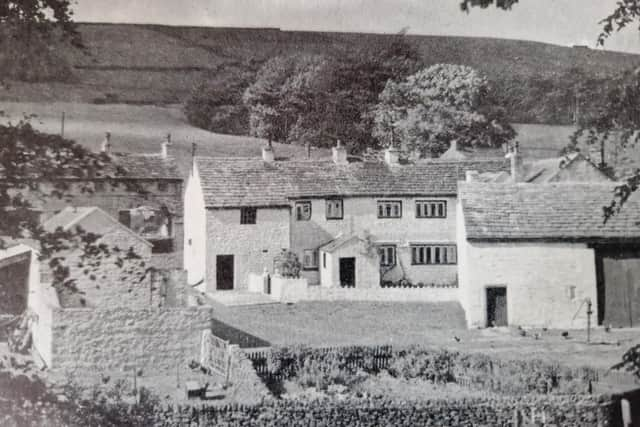
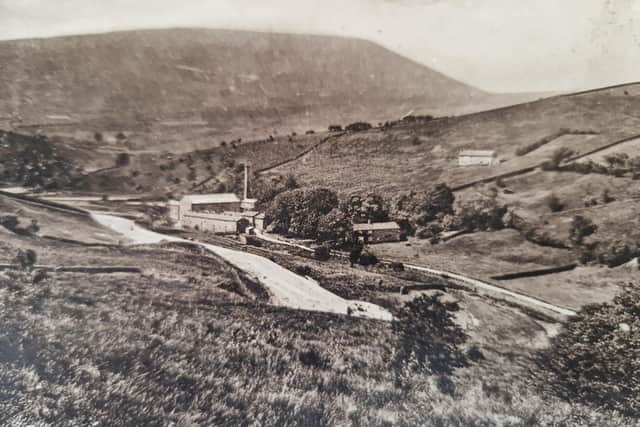
Roger said: “Barley is more associated with witchcraft and mythology, but it’s got this splendid bit of social history. Narrowgates Mill started as water-powered spinning or twist mill. The cotton was woven in the charming cottages in front of the mill. It is a really remarkable village because it’s totally intact.”
We go next to the pub, namely the Pendle Inn, one of two in the village. The Pendle Inn, which has a date stone of 1930, was built by the Burnley brewery Masseys or Astleys of Nelson, Roger tells us. The two merged in the 1920s.
From the pub we venture a little further out from the village to what is now a secluded settlement of modern and old houses, and the location of the Whitehough Outdoor Education Centre, known by generations of students who will have stayed there over the years.
Whitehough, though, was actually a house built in the late 16th Century by the Bulcock family, altered later on, but the bulk of the original building is still there.
Finally, we look at Barley Methodist Chapel where Roger reveals that Barley does not indeed have a proper ‘church’, with one exception. A barn opposite was used as a temporary Catholic ‘church’ for the Irish workers who helped to build the nearby reservoirs.