
£12m. data centre bid under iconic hotel
Mysterious plans to create a subterranean data centre beneath one of Burnley's most prominent landmarks have sparked questions about energy use and environmental impact.
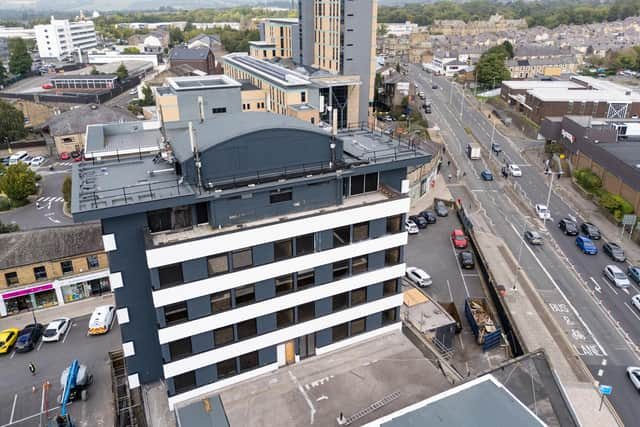
The proposal would see the underground car parks and basement of The Brunlea Hotel on Keirby Walk converted into a £11.98m data centre that covers 4000sqm of floorspace beneath the building.
Documents submitted to Burnley Council are scant on information about the operation of the data centre, with the applicant describing the scheme as change of use. It is not clear who would be using the data centre, how much electricity it would consume, or if it would create any jobs.
The proposal is linked to Real Big Group, a Burnley-headquartered firm which has expanded rapidly in recent years across the property, hospitality and leisure sectors. The company describes itself as a “family of businesses built in Burnley” and operates a portfolio including hotels, estate agencies, lettings, property technology firms, and entertainment venues.

Much of what is known about the project’s scale has emerged not from the planning application itself but from industry sources.
Construction intelligence company Glenigan has described the proposal as a £11.98 million project involving the conversion of 4,047 square metres of existing space into a data centre.
In a LinkedIn post, a Glenigan employee said the development demonstrated how former commercial buildings were increasingly being repurposed to meet growing demand for digital infrastructure.
If accurate, that valuation would place the Burnley scheme among the larger commercial investment projects currently proposed in the town centre.
The proposal would also create a new purpose for a building with a long and complicated history.
Known to generations of Burnley residents as the Keirby Hotel, the landmark town centre building opened in 1960 and was once regarded as one of Lancashire’s premier hotels.
Over time it fell into decline and spent years at the centre of debates about its future, with some calling for restoration and others arguing it should be demolished altogether.
But a fresh chapter appeared to open in 2024, when plans emerged for a major redevelopment of the site.
At the time, Real Big Group’s Michael O’Hagan announced ambitious plans to transform the former hotel into a luxury hospitality destination. The vision included leisure facilities, a spa and new parking provision, with supporters describing the scheme as an opportunity to help revitalise Burnley town centre.
Today, the redevelopment is being marketed under the group’s Beyond Hotels brand.
The firm’s website describes the scheme as a “landmark development” opening in 2027 with promotional material referring to 32 luxury hotel rooms, two penthouse suites and four apartments already available to book.
But while the plans for Brunlea Hotel’s above ground business are being advertised, the particulars of the subterranean data centre have not been made public through the planning application.
The plans mostly show the proposed facility taking over both the upper and lower underground parking levels of the hotel, along with basement accommodation.
Yet that loss of parking formed part of a formal objection submitted by Burnley Council executive member Cllr Martyn Hurt.
In a detailed representation to the council, Councillor Hurt argued that the documents submitted with the application do not provide enough evidence to properly assess its impacts.
He noted that the proposal would remove the hotel’s underground parking provision yet is not accompanied by a transport statement, transport assessment or parking study – which would explain the impact of losing this parking on nearby roads.
Cllr Hurt also questioned the absence of air quality assessments, energy information, carbon impact evidence, drainage details and noise assessments.
His objection highlighted what he described as inconsistencies within the planning documents themselves.
While the application form states the development site extends to more than 4,000sqm, a separate section claims exemption from Biodiversity Net Gain requirements on the basis that it covers less than 25 square metres.
He also raised concerns about flood risk information and the potential utility demands of a large data centre.
Data centres are among the most energy-intensive forms of development, requiring significant electrical capacity and extensive cooling systems to prevent servers overheating. Questions around electricity demand, cooling technology and water consumption have become increasingly prominent in planning applications for digital infrastructure projects across the country.
Some of those issues have already been raised by consultees.
Correspondence submitted to the council’s planning portal shows that both United Utilities and the council’s environmental health team sought further clarification from the applicant regarding cooling arrangements, drainage and the location of any external plant equipment.
Environmental health officers also wanted further information about potential noise impacts from the cooling system.
Responding on behalf of the applicant, planning consultant Claire Bradley told planners that the proposed facility would use a “closed-loop system” and that any cooling equipment would be located either underground or within a roof enclosure.
Despite Glenigan valuing the development at almost £12m, the planning documents do not identify the future operator of the data centre, explain why Burnley was chosen as its location, or set out its anticipated power requirements.
The outcome of the application will be determined by Burnley Council at a later date.
The Real Big Group has been approached for comment.