
Clarets Big Interview: Former Burnley crowd favourite John Francis talks to Craig Salmon
Clarets Big Interview part one: Former Burnley cult hero John Francis recalls his promotion-winning goal and the night he shut-up his racist abusers
He’s watched the exact moment back countless of times, even pausing the grainy footage on YouTube; he’s re-run the incident in his mind on endless occasions over the years - and still, to this day, John Francis cannot fathom which part of his body got the final touch to the goal which sealed the end of Burnley’s long years in the wilderness.
Twice champions of England over their 144-year history, the Clarets had sunk to the depths of the bottom tier of English football in the 1980s - almost dropping out of the Football League altogether in 1987, a 2-1 victory over Orient at Turf Moor on the final day of the season rescuing the club from almost-certain oblivion.
The outpouring of relief among supporters in the immediate aftermath of that match gave way to the feeling of hope in the ensuing years as the Clarets targeted a rise back to where the club felt it rightfully belonged.
A fairy tale run to Wembley the season after in the Sherpa Van Trophy - albeit which ended in a 2-0 defeat to Wolverhampton Wanderers in the final - was perhaps the tonic everybody connected with the club needed after a fraught few years.
However, the ultimate goal of promotion out of the old Fourth Division was the Holy Grail.
Signed in 1990 on deadline day from Sheffield United by manager Frank Casper for a sizeable sum in those days of £90,000, striker Francis was tasked with the job of firing the Clarets to glory.

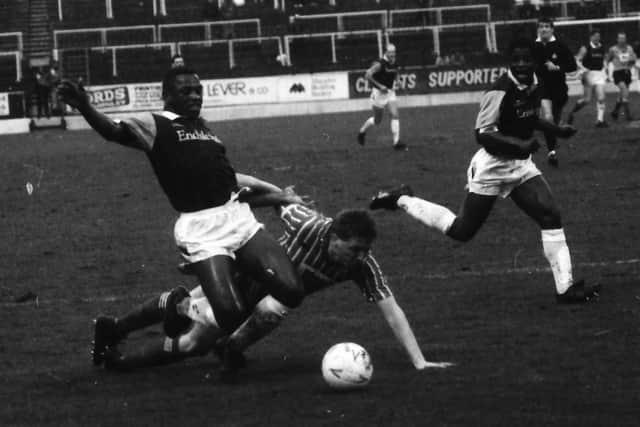
Nineteen goals in his first full season at Turf Moor was a terrific return but ultimately was to be in vain as Burnley were beaten in the play-off semi-finals over two legs by Torquay United.
Shifted out to the right wing to accommodate the arrival of Mick Conroy alongside Roger Eli the following season, Francis was an integral member of the Clarets team which stormed to the league title under new boss Jimmy Mullen in the 1991/92 campaign.
He made 50 appearances, notching 11 goals to boot - none more important than the last-ditch winner at York City’s Bootham Crescent which clinched a 2-1 victory - and promotion, ending seven long years stuck in the bottom division.
Thousands upon thousands of away supporters had travelled expectantly across the Pennines but things did not quite go according to plan at first as the Minstermen took a shock 1-0 lead.
The Clarets were not to be denied though as midfielder John Deary, via a deflection off Robbie Painter, levelled matters deep into the second half and it was left to Francis to hit the stoppage-time winner.
Not that he knew much about it! Arguably there was only Francis capable of keeping pace with Conroy, who had made a lung-bursting run down the left.
The Scot’s sliding cut-back from the by-line diverted off Francis at the near post into the back of the net.
Whether the ball ricocheted off his hip, thigh or backside, the speedy striker cared not one jot. All that mattered was seeing the net bulge, signalling pandemonium in the away terrace behind the goal.
Written in the stars
While there were joyous scenes in the dressing rooms afterwards, there was also a poignant moment as the squad remembered a member of the Clarets family who had lost his life a few months earlier.
Young apprentice Ben Lee tragically died when he fell through the roof of the Longside at Turf Moor as he attempted to retrieve a ball.
The period of mourning resulted in the away game against York being postponed - it being rather fitting that the team would secure the title by winning the rearranged fixture.
“I still don’t know what part of my body the ball touched for the goal,” Francis said. “Honestly!
“It all happened so quickly, but when it went in, it was just sheer elation. What a night!
“We actually thought we had won promotion at Carlisle - the game before.
“I remember being gutted on the coach going home after we drew the game.
“But when you reflect on it, the original game against York got postponed because of young Ben who passed away.
“Maybe it was written in the stars.”
Burnley fans almost took up three sides of Bootham Crescent and the memory of the jubilant visitors chanting “Burnley Are Back” during the celebrations afterwards still make the hairs of the back of Francis’ neck stand up.
“It’s something that you remember for the rest of your life,” Francis added.
“It was unbelievable how the fans took over the grounds for both the Carlisle and York games.
“I remember seeing the pictures afterwards of I think it was Micky Conroy and Joey Jakub in the stands at York and there was just a wall of Clarets fans.
“It was just a great time. The club, the town was buzzing especially from where the club had come from having nearly gone out of the league a few years earlier.”
The perfect riposte to sickening racist abuse
If that was arguably the greatest moment of Francis’ Clarets career, the game he is perhaps most remembered for by Burnley supporters came a couple of years later in 1994.
The striker’s virtuoso performance against Plymouth Argyle in the old second division - now League One - play-off semi-final second leg has gone down in folklore.
After the first leg ended in a goalless draw at Turf Moor, the Pilgrims seemingly tightened their grip on a place at Wembley when they took an early lead at Home Park.
However, Francis turned the tie on its head with two almost identical goals in quick succession in the first half.
Fed by strike partner Adrian Heath, Francis outstripped the hosts’ defence for pace before slotting the ball past the keeper.
It was the perfect riposte from Francis considering he had been subjected to sickening racist abuse from certain sections of the home terraces.
The verbal taunts and monkey chants were certainly rammed back down the throats of his abusers - and he let them know in no uncertain terms with the way he celebrated both goals.
“You look at the first game against Plymouth at Turf Moor, they were quite strong and were quite physical,” Francis recalled.
“They came away with a result and they probably thought they had done enough.
“We were probably favourites to win that game and we probably felt we should have done better.
“But we were quite positive when we went down to Plymouth because we knew what type of players that we were and what we could do.
“We felt it would suits us. We could soak up the pressure and counter.
“That’s how it worked out on the day. We had a plan when their play broke down, we would go forward early.
“It worked twice in a way. They could not cope with our pace and when you have got Adrian Heath, who was on the shoulder of everything, he was able to knock the ball in behind them.
“You look back at the racist abuse - it’s something which wouldn’t happen now or shouldn’t happen because it is illegal, but it wasn’t then.
“As soon as I got the ball, I would hear the monkey chants, the jeers, the verbal taunts - when I scored the first goal I ran away saying, ‘The Monkey has just scored against you’.
“If I had have done that nowadays, I would have got myself in bother for inciting the crowd.”
Thankfully, such racist abuse is relatively a thing of the past at football grounds these days, although that is not to say it has been completely eradicated from the sport especially with the rise of social media over the past couple of decades.
Campaigns such as Kick it Out and Show Racism The Red Card have helped in the fight against racism but Francis insists there should be no complacency.
He welcomed the ruling which saw players receive red cards for covering their mouths when in confrontation with an opponent during the recent World Cup.
He admits that for black players such as he and those before him, being subjected to racism was - although hard to imagine - part and parcel of being footballers.
“It was kind of water off a duck’s back,” he added. “It had to be. It wasn’t just from the stands, it would be from players that you would come up against.
“Would players do it now? I think there are instances where they are still doing it. Can you get away with it now? You shouldn’t.
“But does it still happen? Yeah, I think it does.”
Read part two of the John Francis story next week in the Burnley Express