
Bygone Burnley: The parish church of St Mary and All Saints, Whalley, with historian Roger Frost MBE
Our Bygone Burnley video article today takes us back to the Ribble Valley and Whalley where historian Roger Frost MBE explores the interior of the medieval parish church of St Mary and All Saints.
As Roger points out, this is no ordinary parish church, indeed it is the greatest in the whole of Lancashire, in his words, and certainly one of the oldest in the entire country.
Work began on building the church as far back as 595AD and was completed in the following century. It sits just a few hundred yards from the equally historically significant Whalley Abbey, featured in an earlier episode.
Most of the present church was built in the 13th Century.

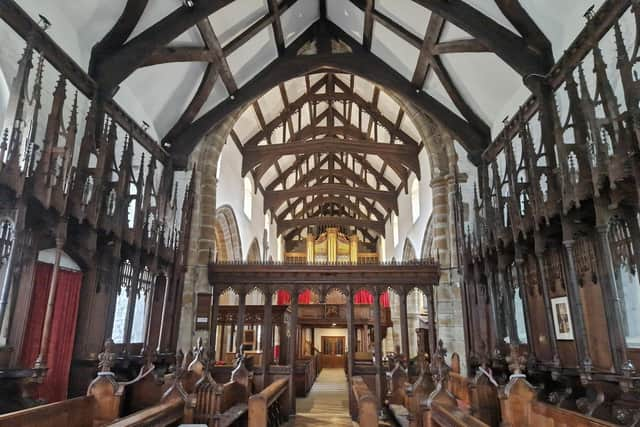
Roger said: “We’re in one of the most historic buildings in the whole of Lancashire. To me, it’s just about the greatest of the parish churches that have survived.
“Lots of towns grew from small villages that had churches, many of which were enlarged or replaced, but here we have a church founded in the late sixth Century containing many important artefacts.”
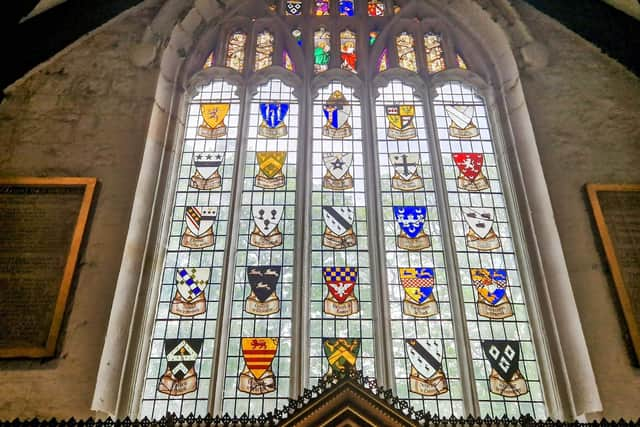
Our first focus is on the church’s impressive chancel window, the stained-glass of which contains the coats of arms of many leading noble and landed families of East Lancashire – with such well-known names as the Towneleys, de Lacys and Parkers.
The great window was inserted into the church by the historian and clergyman Dr Thomas Dunham Whitaker, “one of Lancashire’s great historians”, according to Roger, who revealed that the latter’s book ‘The History of the Original Parish of Whalley’ is where subsequent historians start when studying the history of East Lancashire.
He was also responsible for helping to identify a Roman hoard found at nearby Ribchester, now on display at the British Museum.

The family lived at Holme in Cliviger for many years.
Thomas was the Vicar of Whalley from 1809, as was later his son Robert Nowell Whittaker, memorials to both can be found in the church.
We next look at undoubtedly the most ancient feature in the church – a Roman-era carving of a solider carrying a lance.
Roger reveals that there are several theorires the church may have been built on the site of a Roman fort, unlikely in his opinion, or a signalling station, which are known to have been built by the Romans near Ribchester.
The stone or altar piece featured a soldier, who may have come from what is now Ukraine or Spain, who were known to be garrisoned at Ribchester.
Roger next looks at a window in the lancet style, the shape of which represents a lance. Near to the window is the likely remnants of a piscina, which was used to wash the communion vessels.
Another particularly significant feature of the church is its misericords, originally erected in the nearby abbey. These superb carvings represent various subjects including St George and the dragon, the Holy Trinity, and Roger’s particular favourite – a blacksmith shoeing a goose – a term that has translated into popular parlance as a pointless exercise.
Finally, we look at St Anton’s Cage, originally built for the Nowell family of Read, and subject of later disputes between families.
This magnificent church is open every day from 10am to 4pm and has recently seen work done to restore its organ and bells.