
Bygone Burnley: Holme Chapel, Cliviger, with historian Roger Frost MBE
For our Bygone Burnley episode this week we travel to the parish of Cliviger and the village of Holme Chapel.
Respected local historian Roger Frost MBE guides us around pretty Holme Chapel, nestled in the shadow of the magnificent Thieveley Pike on the road to Todmorden.
In a first for this series, we sent up our drone to capture some wonderful footage and stills of this picturesque setting and some of its well-known historic landmarks including the church of St John the Divine, the Ram Inn and Holme Hall.
We begin, as ever, with Roger explaining the etymology of the name – Holme being a Nordic word for an island – the area being wet before it was drained in the 17th Century.
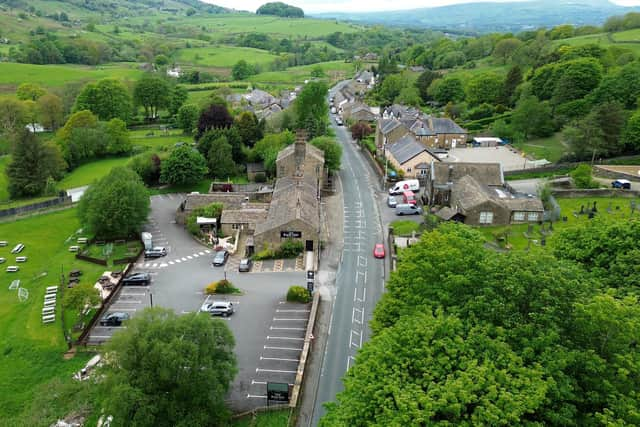

Roger goes on to say that the four main elements of a medieval village can be seen in this small corner of Holme, notably the church, school, inn and old house.
“The only thing missing is a village green,” Roger adds. “Now, in the 14th Century a family lived at ‘Cliviger Green’. The trouble is we’ve never been able to locate where it was, but it must have been somehwere where we are now.”
We next move on the churchyard of St John the Divine Church, the final resting place of the iconic General Sir James Yorke Scarlett who led the charge of the Heavy Brigade at the Battle of Balaclava in 1854, during the Crimean War.
Scarlett died at his Bank Hall estate in Burnley in December 1871 aged 72, and is buried alongside his wife Charlotte Thursby.
Roger adds: “Charlotte obviously became Charlotte Scarlett when she married, a name which people think sounds a bit funny. The General was a great man and his memory is forever recorded here in Cliviger.”
We next explore the church which stands on the site of a small chapel built in 1536, a dangerous time to build a church, being the time of the English Reformation.
“It was built by the Whitakers of Holme Hall, and it lasted for over 200 years,” Roger explains. “As the years went by, priests from St Peter’s in Burnley would travel to lead services. However, in the 18th Century the estate passed into the hands of Dr Thomas Dunham Whitaker, the vicar of Whalley and other areas.
“He decided to pull the old chapel down and build this splendid church that stands today. It represents something in church history that very few other places I know can illustrate. Before it was decided in the 19th Century to continue building Anglican churches with spires and towers like medieval buildings, there was a period where classical designs based on Greek temples were popular.
“If you look at the buildings there are a number of things which indicate its classical nature. It was easier to construct and was built at another dangerous time, notably being in the period of the French Revolution when the aristocracy were coming under fire from radicals.”
Moving on from one place of worship to another, we next look across the road to the Ram Inn where Roger proclaims that “every good village needs a pub.”
Roger reveals that the pub first appears in the records nearly 500 years ago as the ‘pub at Holme’ and was later known as the Cherry Tree. It changed its name to the Ram because the area to the side of the pub became the Cliviger showground, where a sheep fair was held.
“The local breed of sheep was the lonk and this is represented in the pub sign. However, if you look carefully above the ram on the sign there is a chess board and all the instruments of freemasonry.
“This shows us that the pub was used by freemasons for meetings, probably in the mid 19th Century, and its reputedly around that time that the pub changed its name to the Ram. The inn sign is by far the best in Burnley.”
We next look at the neighbouring school, built out of the original stone that the chapel was built from.
Finally, Roger takes us to the Holme, one of three important houses of the past. Built in the early 17th Century, it replaced the original half-timbered medieval manor house owned by the Whitaker family in the 15th Century.
It has now been beautifully restored following a fire and is again a private residence.