
Bygone Burnley: Brun Valley Forest Park, Part Two, with historian Roger Frost MBE
Our Bygone Burnley episode takes us back to the Brun Valley Forest Park, first featured last week, and to more fascinating pieces of our town’s history along its route.
Renowned historian Roger Frost MBE guides us to a trio of fascinating subjects in this part of town – the former Prestige works, Bank Hall and a set of Russian cannons from the Crimean War.
We begin our video this week at Prestige, a fine inter-war building that still stands at the bottom of Colne Road.
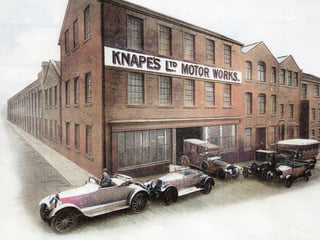
Opened in 1937 as Platers and Stampers, the building later became the Prestige Group’s main factory, and Roger believes, the first in the world to be financed by a local authority out of the rates.

Roger says: “Prestige is one of the most historic buildings in town, despite only being built in the 1930s, but its history is a remarkable one. It was built at a time when a lot of Burnley’s industries of the past – engineering, cotton, mining – were coming to an end. In 1929 two of Burnley’s biggest textile companies closed down, as well as several mines.
“Thousands of people became unemployed. The council stepped in to help. Prestige became the world’s firdt factory to be built out of the rates. It searched the world for a tenant, and found one in America, who decided to base their European manufacturing in Burnley and they produced kitchen-ware which went all over the world.”
We next move across the road from Prestige to the site of the former Bank Hall. The area is now occupied by a care home, but previously was home to two halls, the first a wooden Middle Ages structure, before its more famous replacement – Bank Hall, a grand home, which later became a military hospital and finally a maternity hospital.
Roger explains: “In the 1780s the half-timbered original building was demolished and replaced by Bank Hall, the home of the owners of the mines in the Burnley coal field, the Hargreaves family.
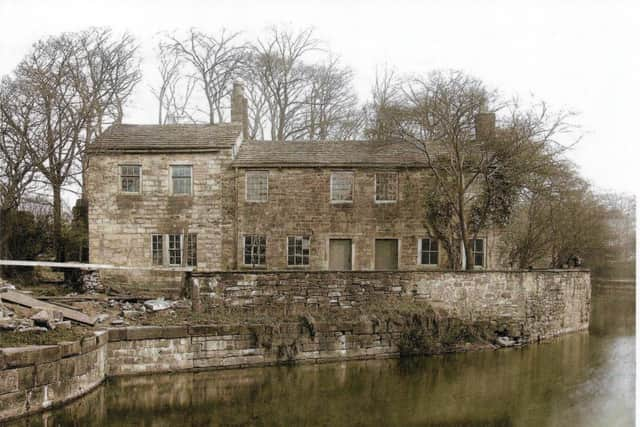
“Ultimately, the two daughters married the Rev. William Thursby and the future Crimean War hero General Scarlet who made it his home. It later transferred to the Thursby family. Eventually, the Thursbys allowed the home to be converted into a military hospital during the First World War. In 1919, Burnley Council bought it for the town’s maternity hospital.”
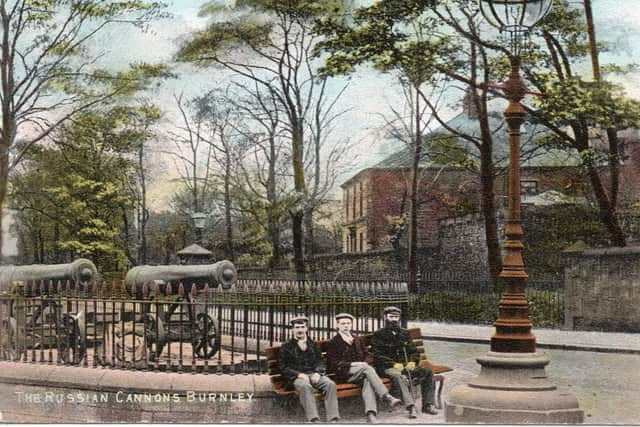
Another feature of this part of town, also closely associated with General Scarlett, was the site of a pair of Russian cannons.
General Sir James Yorke Scarlett led the Charge of the Heavy Brigade during the Battle of Balaclava in October 1854, in which many Burnley soldiers fought.
At the end of the war, and in recognition of this, Burnley was presented with two Russian cannons from the conflict, which took up pride of place at ‘Station Approach’.
Sadly, the cannons were taken south during the Second World War to be melted down for the war effort. However, the metal was found not to be suitable and were dumped out at sea.
Our video ends with a look at Burnley’s weir on the River Brun, dating from the later 13th Century when Burnley corn mill was open.
Finally, we look at the Colne Road bridge, originally called Warehouse Bridge, and the nearby Knightsbridge Buildings, the nurse’s home.