
New equipment installed at Rosemere Cancer Centre will ease side effects of cancer treatment for over 600 patients annually
Use of an LED “showerhead,” which is only the second piece of equipment of its kind in the whole of the North-West, is now being offered to all head and neck cancer patients at Rosemere Cancer Centre.
The Preston based centre, which treats patients across Burnley, Pendle and the Ribble Valley, has been funded by Rosemere Cancer Foundation to prevent and treat oral mucositis, a painfully debilitating and potentially serious complication of treatment.
Chemoradiotherapy, which is chemotherapy and radiotherapy administered at the same time, leads to OM in almost all patients, which often gets worse as their treatment progresses. With its symptoms of mouth ulcers, sores that can bleed, pain, swelling andthroat soreness, it can, in the most severe of cases, even cause treatment to be interrupted.
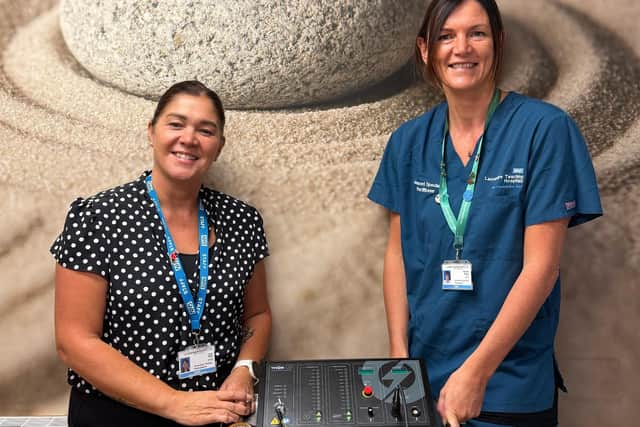

Photobiomodulation (PBM) therapy, which is recommended by the National Institute for Health and Care Excellence for its proven benefits uses low level lasers or LEDs with near infrared light to painlessly target the damaged tissue inside the mouth and neck. It stimulates tissue repair to reduce ulcers, sores and inflammation, easing pain.
Consultant radiographer Lucy Koh and advanced clinical practitioner Rachel Rigby applied to Rosemere Cancer Foundation for the £18,145 needed to buy the PBM unit and a year’s worth of disposal “showerhead” (probe) covers.
Lucy said: “PBM therapy is proven to reduce OM symptoms and improve quality of life where historically, there has been no effective treatment.
“It has no contra-indications or known side-effects and is so easy to deliver that patients, once shown, can administer it themselves at the beginning or end of their treatment appointment.”
There is currently one probe or “showerhead” attached to the PBM unit, which is placed externally against the cheek and lips.
Rachel added: “We estimate around 664 patients a year will now benefit from PBM therapy.
“In the longer term, the aim is to make the machine available to patients using our late effects of radiotherapy disease clinic. We also believe
the provision of PBM therapy will deliver cost savings to the trust by reducing the cost of pain management and invasive forms of nutritional support as well as hospital admissions due to OM infections and treatment interruptions.”