
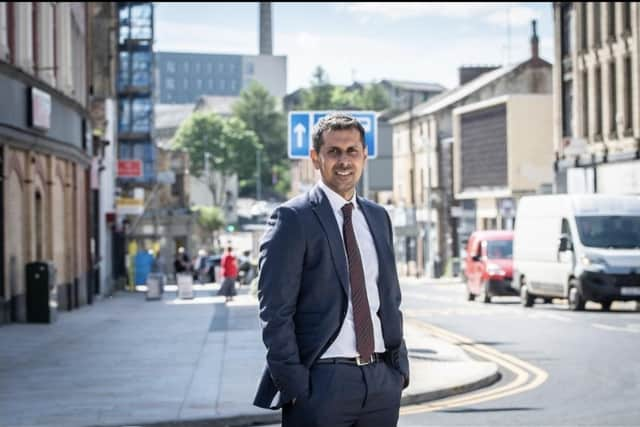
Five unitary councils: a smarter future for Lancashire by the leader of Burnley Council, Afrasiab Anwar MBE
I’d rather government thought through reorganisation from a fresh lens than a 60s and 70s framework.
The current approach to reshaping local government in Lancashire feels like a rerun of outdated thinking, one that risks repeating the mistakes of the past rather than solving today’s challenges with creativity and courage.
Let’s be clear: residents across Lancashire and certainly in Burnley did not ask for reorganisation. There’s no groundswell of public demand for structural upheaval. But it’s the only option on the table, and so we have to play by the rules of the game. That means engaging constructively, challenging flawed assumptions, and fighting for a model that delivers the best possible outcome for our communities.
We’re working within a reorganisation framework that reflects the approach set out by Jim McMahon during his time as Minister. While that structure may not be how I would have chosen to pursue reform, it’s the reality we’ve inherited and I’m focused on getting the best possible outcome for Burnley, for East Lancashire, and for the county as a whole. This is about making the most of a difficult starting point. If we’re going to be reshaping local government for the next 50 years, we owe it to our residents to challenge assumptions, push for evidence-led decisions, and ensure that the most deprived communities aren’t left behind.

I’m pleased that government appears to be moving away from a rigid fixation on the 500,000 population threshold. That’s a welcome shift. But I do hope they are bold enough not to simply use that flexibility to appease political allies or preserve convenience. This is a once-in-a-generation opportunity to build a structure that genuinely works for Lancashire not just one that works for Westminster.
The last major reorganisation in 1974 stripped places like Burnley of their county borough status and local autonomy. That change was meant to modernise governance, but it left communities like ours sidelined. Now, with another reorganisation on the horizon likely the only one we’ll see for the next half-century, we must be bold enough to do better.
The government’s previous fixation on a 500,000 population threshold for unitary councils was deeply flawed. There’s no statutory basis for it, and it’s out of step with reality. The average unitary authority in England serves around 175,000 people. Evidence shows that smaller unitaries deliver better outcomes in adult social care, and that larger ones don’t necessarily offer greater efficiencies. It’s especially concerning that the government leaned on figures from a PwC report that wasn’t commissioned by them and hasn’t been independently scrutinised. This is not how we should be shaping the future of local governance.
The proposed three-unitary model splitting Lancashire into North, West, and East may satisfy the arbitrary population threshold, but it fails to reflect the geography, identity, and logic of our county. Lancaster and Blackpool in the same authority? Burnley and Blackburn grouped together? These combinations ignore the distinct needs and histories of our communities. Early modelling shows that East Lancashire would suffer disproportionate funding gaps, despite the promise of “fair funding” for deprived areas. That promise rings hollow when the most deprived region in Lancashire is left behind.
The five-unitary model offers a far more coherent and locally sensitive solution. It keeps Lancaster separate from Blackpool, allowing Lancaster to retain its historic status and civic identity, rather than being absorbed into a mismatched authority. It keeps proud towns like Burnley and Blackburn distinct, preserving their unique character and enabling tailored approaches to regeneration and service delivery. It also allows deprivation to be meaningfully addressed. By giving East Lancashire two out of five seats on the strategic authority, we ensure that the most deprived areas aren’t just heard they’re empowered. And if all that weren’t reason enough, it even keeps Preston and Chorley apart which, I’m reliably informed, will keep Sir Lindsay Hoyle quietly content. Let’s call that a diplomatic win with a wink.
The four-unitary model is even more troubling. It would create the most deprived unitary council for East Lancashire in the country, and the largest in Lancashire, yet give it just one seat out of four on the strategic authority. That’s not representation, it’s tokenism. If we’re serious about levelling up, we must give deprived communities more of a voice, not less.
Let’s be honest: none of the three upper-tier councils in Lancashire have a strong track record in adult or children’s social care. If the plan is to roll forward their leadership into a new continuation authority, we’re setting ourselves up for failure. We need fresh thinking, not recycled governance.
While the two-tier system has its flaws, reorganisation alone won’t fix what’s broken. Why aren’t we tackling the real issues – SEND provision, adult social care, housing, transport, economic regeneration with creativity and ambition? Why are we still using models conceived in the mid-20th century to solve 21st-century problems?
Right now, I may be a lone voice alongside the leader of Pendle amongst political leaders in Lancashire. But I will fight tooth and nail to get the best outcome for Burnley, for East Lancashire, and for Lancashire as a whole. The modelling shows that five unitaries is the best option. Let’s hope the final decision is based on evidence not political convenience or lobbying pressure.
Lancashire deserves better. Let’s be bold enough to deliver it.