
Fears over 77-home plan for historic Read parkland
A plan for 77 homes on historic parkland in Read has sparked fears of over-development – and potentially a total of 700 homes being built there in future.
There are also fears that development would harm the site’s historic importance including links to a listed hall and the Pendle Witches.
Seventy-seven houses are proposed for the land in the village of Read. The site is known as Hammond Ground, north of Whalley Road, and associated with Read Hall. Developers say the new estate would be well-designed with significant green space kept along with new trees and a pond.
However, local objectors have formed a campaign group, called Save Hammond Ground, to fight the application, which has been submitted to Ribble Valley Council.
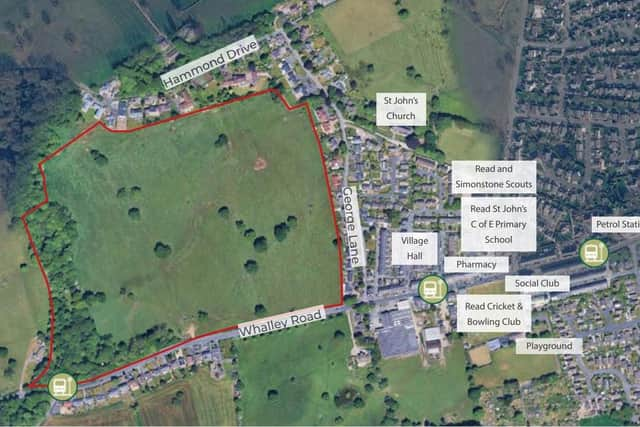

Resident Mark Murphy is the group’s chairman and said a recent public meeting about the application drew around 100 local people. He said: “We believe this would permanently alter one of the village’s last remaining areas of open parkland and further-accelerate the spread of suburban-style housing across the Ribble Valley.
“There are serious concerns about ‘urban creep’ between local settlements, traffic congestion on already-pressured roads and strains on doctors’ surgeries, schools and infrastructure
“Also, the site forms part of the historic setting of Read Hall, a Grade II* listed country house in a landscape which has shaped the village’s character for centuries. We are worried about the impact on the hall estate and a precedent being set for future expansion on adjoining land. The design of the plan suggests up to 700 homes could be built across the wider site in future phases.”
The group has also questioned the ownership and financial structure linked to the Read site, saying some trustees are understood to live in offshore tax jurisdictions.
In the 1600s, Read Hall was connected to Roger Nowell, a Sheriff of Lancashire and magistrate at the time of the Lancashire Witches trials in 1612. He sent the ‘Pendle Witches’ to Lancaster for trial and it is understood some of the women were kept at Read Hall, or nearby, for some time.
Now, Preston-based developer Applethwaite is behind the new homes plan, working with agents Connollys in Rossendale. Connollys has run public consultation about the plan and was approached for comment regarding the campaign group’s arguments.
In their planning reports sent to Ribble Valley Council, the developers have included maps of Read and Read Hall going back to 1786.
And their design statement for the proposed new homes says: “The site would be structured around a comprehensive green infrastructure network, with the majority of land retained as green space. This would establish a strong, landscape-led approach with development concentrated to the eastern edge
“We have carefully considered the opportunities and constraints of the site, the needs of local residents and council policies. Our design approach has been led by technical consultants who understand the context of the site and the surrounding area.
“We truly believe we have designed a scheme which goes above-and-beyond the needs of future residents, whilst helping Ribble Valley Council to meet its housing aspirations. The site is well located to achieve all of this
“Also the proposed architecture is designed to be sympathetic to the local context. It employs high-quality materials, expressed in a traditional style. The majority of the site would be retained as a large, newly accessible parkland area on the west and central areas. There would be existing and proposed tree planting, footpaths and areas for informal recreation.
“In the south-west corner, a pond forms part of the sustainable drainage plan, set in a landscaped area and amenity space.”
Malcolm Peplow, a Ribble Valley councillor, attended the recent public meeting in Read. Speaking after, he said: “Hammond Ground is loved and valued by residents, and anyone driving through local villages will appreciate its beauty. But if 77 houses are built, it will result in a loss of open countryside, harm important views, permanently change the character of Read and damage the historic, visual approach into the village.”
He added: “Read and Simonstone are already overwhelmed with through-traffic, as a result of the over-development of Clitheroe, Whalley and Barrow. There is only one pedestrian crossing for the two villages on an extremely busy, dangerous road.”