
Alastair Greene on making hard work pay off
Barnoldswick is set for an evening of deep-South blues, swampy grooves and twin-guitar Southern rock thunder on Monday as the Alastair Greene Trio and The Southern Rock Band take over the Music & Arts Centre for a rare double-header. Ahead of the show, I caught up with Greene himself for a two-part interview for the Express.
Following his departure from the prestigious Berklee College of Music, Greene returned to California, performing in various bands as a guitarist and vocalist. However, in 1997, the guitarist compiled a band under his own name, subsequently launching the Alastair Greene Band. When speaking with Greene, he admitted the process of launching his own project at the time was a gamble and the idea of singing was particularly daunting initially.


“I was sort of chasing this idea in my head that a lot of my heroes also sang. And maybe they weren't the best singer in the world, but they got it done. And so you're really able to express everything that you want to express,” Greene explained. “I consider myself a guitar player first, a songwriter and riff guy second, and a singer third. And so it was daunting, but it was one of those things where I had enough positive experiences to know that I wasn't completely crazy. And I'm happy I did it. I mean, it's led me to a lot of really good opportunities, and I chose to take that on, not only as a solo artist but also in learning how to sing in front of a band, and that kind of stuff has led me to some other cool side band things too, because I just sort of embraced being able to do all those things,” Greene finished.
Speaking of good opportunities, early into his solo career, Greene earned the opportunity to support the Fabulous Thunderbirds on tour and gained mentors in The Pontiax’s Mitch Kashmar and Jack Kennedy, who served as Greene’s bassist, and The Pontiax’s Tom Lackner served as Greene’s drummer.
“These are the guys that were; my first rhythm section were these guys that I really looked up to in the blues world that had toured and made some records,” he said. “I'd heard of the Fabulous Thunderbirds, and I was aware of them because in the early eighties or the mid-eighties, they had a couple MTV hits, which I thought were cool. But when I got into blues and blues rock, of course I'd heard; you know, Stevie Ray Vaughan was one of the big names in that world. And of course I knew his brother was Jimmy, but I hadn't really dived into that music.
“And so when I did, Jack turned me on to the Fabulous Thunderbirds, and I heard those first, really the first four records, but the first two in particular are just killer, killer records all the way around. And the band had changed a lot. So by the time I opened, it was basically Kim Wilson with the guys that he put around him at the time. But the guys that he put around him at the time were just slayers, were just these guys that were just killers. In that lineup, there was a guy named Kid Ramos who was playing guitar, who's just badass, just killer. Jimmy Bott was the drummer. Willie Campbell was the bass player. And I think Gene Taylor was the keyboard player. And it was, I mean, they were smoking. So it was very eye-opening. It's like, wow, like these guys are still killing. I mean, they're not that much older than I am, but at the time, anyone that's 10 years older than you, it was like, wow. They were just slamming. And it was really inspiring. And they're still going. I mean, it's still Kim Wilson. He's got great players, and they're still going and doing it. So it's just sort of a testament to, man, if you're in it to win it, you can keep it going,” Greene finished.
Alastair Greene’s longevity

The longevity of the Fabulous Thunderbirds is particularly impressive, and the same could be applied to Greene, who released his debut album – 'A Little Wiser' – in 2001. “Stop it. Don't tell me that,” Greene joked after he was reminded about how long it has been. Including his live albums, Greene has now released a total of ten records to date as a solo artist, but it was only in 2014 that the guitarist secured a deal to release his ‘Trouble At Your Door’ album through Eclecto Groove Records. To self-release his music was an act that required determination, and that work ethic paid off.
“The business model that I had just sort of grown up with was you start a band, you write some songs, you get your shit together, you play some gigs and you go down to L.A. and you try and make something happen for yourself. That was one career trajectory. And as I got older and got into blues and started hearing these other things, I realised, 'Oh, man, you can go tour on your own, you can make records, you can do these things on your own.'
"And that happened more in what I was seeing and whatnot. At one point I was like, 'Man, I'm not going to wait around for a record deal to magically fall out of the sky.' And so I started making my own records, and sure enough, I stuck with it long enough and did these things long enough that eventually, you know, after a decade or whatever, I ended up starting to get record deals. But it was definitely sort of like, Man, I'm just going to start doing this and maybe it'll pay off,” Greene stated.
The big pay off for Alastair Greene
Greene’s determination certainly did pay off. After meeting a local DJ called Mike Dawson in Santa Barbara, California, Greene was invited to record some overdubs inside a home studio, which belonged to Alan Parsons, songwriter, musician, record producer and audio engineer who worked on ‘Abbey Road’, ‘Let It Be’ and Pink Floyd’s ‘Dark Side of The Moon’. The sight of seeing platinum-selling plaques awarded to Parsons and photos of him and Ringo Starr on the walls of his home studio left Greene awestruck, but what happened next was the real pinch-me moment.
“I was overdubbing guitar rhythm parts and some solos. And then at a certain point he came in and started asking me to try different things out. And, in my head, I was like, this is an important moment. I don't want to suck right now. Alan Parsons is producing me for lack of a better term. (He’s) like, hey, why don't you try this? He was getting involved. So I must have done a couple things right. And he asked me for my phone number,” Greene reflected.
Almost a year later, Greene was contacted by Parsons, inviting him to return to his Santa Barbara home to perform on his solo album – 'A Valid Path’, playing on two songs on the album. After he was finished playing his guitar parts, Parsons revealed a little detail that left the guitarist stunned.
“I'm glad I did this when I was done,” Greene said with a chuckle. “I said, well, who else played guitar on the album? And he's like, oh, no one really. Just some guy named David Gilmour. And I was like, whoa. And he's like, 'Do you want to hear his track?' And I'm like, yeah, I'll hear it now that I'm done with my stuff. Like, if he told me that beforehand, I might have had a different experience. You know what I mean? Like, I could have been like, oh, fuck. Like, David Gilmour playing on this record. Like, I might have got in my head. And so he played me that. I mean, it's just, it's like a little footnote in the story, but it's like, 'Hey, I played on the same record as David Gilmour,' Greene said with a hint of pride.
A lot of homework

However, Greene’s working relationship with Parsons didn’t end there. After the now 77-year-old’s guitarist Godfrey Townsend was unable to tour due to a scheduling conflict, Parsons invited Greene to accompany him on a tour of the West Coast; Greene accepted the offer in an instant. But the decision to accept Parsons’ offer left Greene with a lot of homework to do, according to the guitarist.
“It wasn't the music that I'd grown up with. I was into hard rock and blues rock and stuff. And this was, for lack of a better term, what I call 'kind of progressive pop'. I mean, that's sort of what I consider his music, if I had to give it a definition. And so I had a lot of homework to do. I was familiar with a few of the songs, but I had to do a lot of stuff,” Greene remembered.
“This is kind of where some of my experience with music school and learning things kind of came into play. I would make charts for myself and learn these songs and write these things down and make some notes. And so I did these shows, and it was really, and there wasn't really any rehearsal. I mean, it was sort of like, learn your shit, and then we'll have a long sound check. And I was like, 'Well, damn.' The first gig that I did with him, I'd actually sat in a couple of times when he was in Southern California and played on the song that I played with on his record. So I had actually been on stage with him two or three times, just playing one song.
“And that was a rush on its own. I was like, wow. So when I finally did these shows, the first show we did was with this; it was like this special event. There was, like, this laser production company that was doing it on, and then there was a Pink Floyd tribute band opening the show, and Alan did front of house and mixed it. So it was like, the guy that used to mix Pink Floyd is mixing the Pink Floyd tribute opening act band. And then we got up, and it was my first time really using in-ear monitors. And there are lasers and smoke going on. And it was like, man, if I can do this, like, I will be able to do a lot of, you know, because it was very distracting and crazy,” Greene concluded.
The art of learning how to honour songs
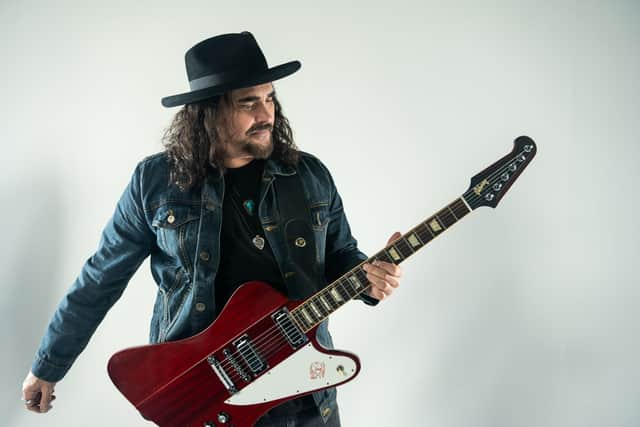
Six months after the shows, Parsons contacted Greene yet again, inviting him to join the Alan Parsons Project on a permanent basis after deciding to create a new version of the band. Greene played with the band between 2010 and 2017 and even earned the opportunity to sing the hit ‘I Wouldn't Want To Be Like You’ and the track 'Prime Time’.
“It was an amazing experience. I learned a lot just about how to play big shows and how to kind of deliver under pressure and how to learn songs. And over the course of my time in the band, I learned more and more about honouring the songs,” he explained. “When I joined, Alan gave me a lot of leeway just because I had to learn so much material so quickly. And over time, he kept going, like, 'Hey, that's cool, (but) can you play this more like the record?' And at first, I was just like, well, man, I'm having fun jamming my blues rock licks over this.
“But then I was like, the people that are showing up that have been into his band since 1974, whenever the first album came out, are kind of expecting certain things to happen musically. And so through that experience, I really learned how to start honouring these songs. Maybe not note for note for note perfection, but trying to recreate the vibe and the feel, which for me was very challenging because the guy that played on those records for the most part, a guy named Ian Bairnson, was coming from a completely different place musically. I think, from a jazz and classical (background) and composing these beautiful solos.
“And I was more Jimmy Page; let's rock – that was where I was coming from. So I learned a lot from that experience. And I got to see the world, man, with my guitar and go places I never would have thought I'd ever see multiple times,” he concluded.
You can catch the Alastair Greene Trio and The Southern Rock Band at Barnoldswick Music & Arts Centre on Monday evening, with tickets available at https://www.barnoldswickmusicandartscentre.com/the-southern-rock-band-alastair-greene. You can also read the first part of the interview with Greene at https://www.burnleyexpress.net/news/alastair-greene-on-grasping-opportunities-with-both-hands-8751162