
Bygone Burnley: Reedley Hallows, with historian Roger Frost MBE
Our Bygone Burnley episode today takes us to Reedley Hallows, a scattered urban and rural area that straddles the border between Burnley and Pendle.
Historian Roger Frost MBE guides us around the area, which encompasses Barden Lane and Colne Road towards Brierfield.
It was a wildly diverse part of town that contained several significant mills, grand houses, rolling countryside and Burnley’s first sewage works.
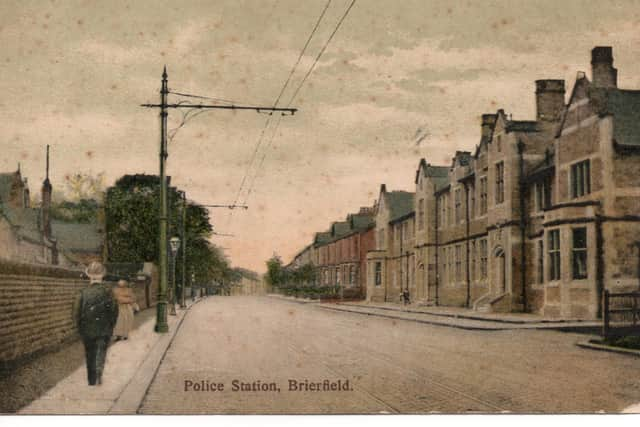
Today, the mills are long gone, but the fine buildings still remain, notably along Colne Road in the shape of the Oaks Hotel, originally built as the home of Victorian entrepreneur Abraham Altham, the former Reedley Magistrates’ Court, Reedley Hall, now the home of Pendleside Hospice, and many domestic properties.

Roger begins by explaining the etymology of the name – ‘ley’ meaning a clearning, in this instance, where reeds grew. The ‘Hallows’ part of the name does not have a religious origin, in Roger’s opinion, as there is no evidence of religious buildings in the area.
“It could mean land detached from the township, and this makes sense,” Roger states. “Part of Reedley is known as Filley Close. I believe this is connected to the horse-rearing establishment at nearby Ightenhill Manor House in the Middle Ages.
“We know there were scores of horses reared in the area during the Middle Ages, which would have needed a lot of land. I think Reedley Hallows is that detached area.”

Roger goes on to look at the Oaks Hotel, built in the 1880s by entrepreneur and grocer Abraham Altham, who established Altham’s Tours. The original name of the building was Oakleigh. Altham did not live in the building for long as he died relatively young.
“It later became the base of the Burnley Rural District Council until 1974 when it was abolished. Shortly afterwards it became a hotel.
“Reedley has a lot of very attractive houses. It was a place where Burnley’s successful businessmen came to live, including Altham and the Bishop of Burnley. It still has a look of a prosperous community.”
We next travel to Holme End, off Barden Lane, where there was a unique visitor attraction in the 19th Century – pleasure gardens run by John Moore attracted familiies with refreshments and play facilities, as well as gardens producing fruit and vegetables. However, the main attraction was John Moore’s monkey, a rare sight in the 1800s.
“For more than 100 years, ‘Jack Moore’s Monkey, was a huge attraction. There were generations of monkeys after the death of the original,” Roger explains.
Our next port of call is a short hop across the road to the former Bridge Inn pub, frequented by pleasure garden customers, as well as miners who worked at the Woodend Pit, now occupied by a fantastic mining museum.
From here we travel to the ‘royal’ area of Reedley, the hill where the roe deer lived. A red brick wall is all that remains of Burnley’s first sewage works, the Duck Pits, next to Pendle Water.
Finally, we look at the two mills that once stood on opposite sides of Barden Lane. Notably, the magnificent Lodge Mill, a siginificant spinning operation that was destroyed by fire in 1905, replaced by an interesting weaving shed.
It was in that building that the world’s first waterproof cloth, Grenfell, was invented by a man named Haythornthwaite.