
Bygone Burnley: Burnley Town Hall council chamber with historian Roger Frost MBE
Our Bygone Burnley episode today sees us escape the winter weather and seek sanctuary in the warmth of Burnley Town Hall’s historic council chamber.
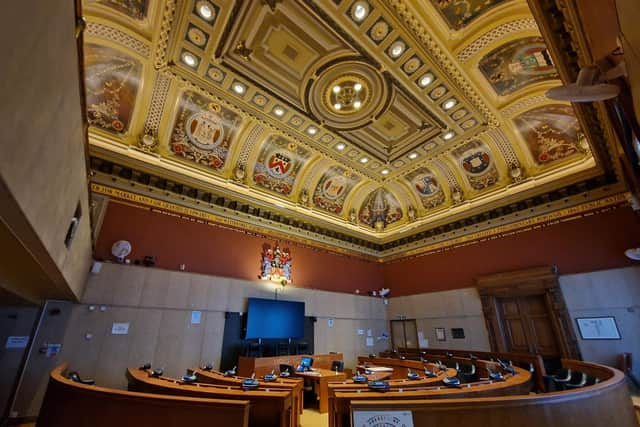
In what will be the first of several articles looking at Burnley’s superb civic building, historian Roger Frost MBE guides us around the town hall’s main council chamber where the borough’s elected representatives sit to carry out their duties.
Officially opened in 1888, this fine late-Victorian building remains one of the most impressive across the whole borough. Its main chamber, meanwhile, tastefully marries a mixture of classical decoration and functions of modern government, adorned with the crests of neighbouring boroughs above a hemicycle seating arrangement.
Roger begins with a potted history of Burnley’s beginnings, starting in the 1500s when it was a sizeable village, albeit one with no real facilties, particularly a town hall.

He said: “Most of the functions of the day centred around St Peter’s Church at this time. However, in the 17th and 18th centuries Burnley began to grow into a country town and the vestry as it was called, in other words the committee responsible for both the secular and ecclesiastical governance of a parish, moved to the town centre and what is now St James’ Street, meeting in the Swan Hotel.
“This group had a rival – the improvement commissioners – who met in the Bull Hotel. Between the two of them, although neither were democratic, they had responsibility for running the town.
“In 1861 these two bodies merged into one body and Queen Victoria made Burnley a borough.”
A document testifying to this last point is just one of several fascinating historical artefacts dotted around the Burnley Council chamber.
Others include the town bell, used in centuries past to herald the announcement of major news among other things, and various different mayoral chains of office.
Another striking feature of the chamber, Roger highlights, is an impressive door which leads from the chamber to an ante-room and thence to the Mayor’s Parlour.
“The woodwork and the carvings are magnificent, and were made locally,” he said.
Equally, if not more impressive, is the ceiling which Roger describes as “a work of art”, part of which has been restored recently.
Roger added: “The ceiling reminds us of the status of Burnley in 1888. Burnley’s coat of arms, which takes pride of place in the centre, is surrounded by the crests of big citires like Manchester and Liverpool. Preston, Bury and Blackburn also feature. Burnley was as important as these places in 1888.
“Another function on the ceiling is a potted history of the town with significant dates and events featured. It begins in 1294 when King Edward I granted Burnley a market charter.
“In 1865 Burnley was a county borough and purchased the markets and fairs. Ever since, Burnley Market has been owned by the people of Burnley. Two years later Burnley was created a parliamentary borough.”
Roger next looks at the current coat of arms, which was created in 1974. An older coat of arms, when Burnley was a county borough was commissioned in the 1840s.
“The coat of arms memorialises the four main families of Burnley – the Starkie, de Lacy, Towneley and Shuttleworth families. References to Burnley’s cotton industry, coal and agriculture are also included.”