
Shakespeare, Sherlock and the Shire on display at Stonyhurst College - the world’s oldest English-speaking museum
Saintly relics, royal robes and precious prayer books were just some of the rare treasures we were treated to an exclusive glimpse of when we visited ‘the world’s oldest English-speaking museum’, located in our very own Ribble Valley.
Stonyhurst College, the renowned Catholic public school in Hurst Green, kindly allowed myself and colleague Kelvin Stuttard to shine our light on its marvellous museum and historic libraries, with more than one claim to fame.
Indeed, religious reliquaries compete for space alongside the college’s literary connections – yes, Shakespeare, Sherlock and The Shire all feature as we will see later.
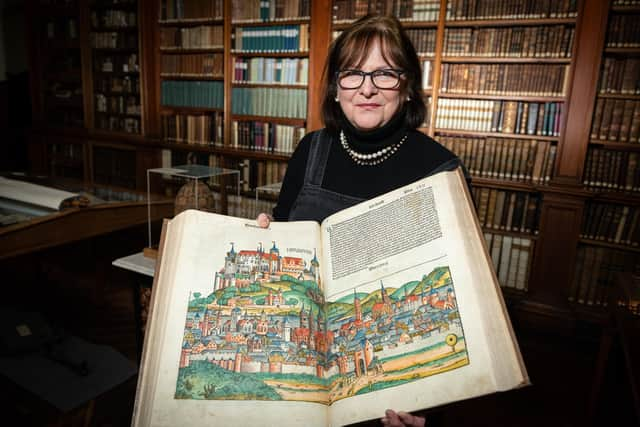
Dr Jan Graffius, Stonyhurst’s fastidious Curator of Collections, donned her white cotton gloves to give us a close-up look at some of these unique treasures including Mary Queen of Scots’ red velvet prayer book, hats belonging to St Thomas More and even a thorn, believed to be from Christ’s crown of thorns.

But it is a beautiful golden garment, once exhibited by no less than King Henry VIII with pomp and pageantry at the Field of the Cloth of Gold in 1520, that serves as Stonyhurst’s unique longevity claim.
Although Oxford’s Ashmolean Museum opened to the public in 1683, Stonyhurst’s claim relates to the vestment, which was made for Henry’s father, King Henry VII, in 1495.
Jan explains: “During the Reformation, when priestly vestments were being destroyed, the beautiful velvet garment was smuggled out of England for safekeeping and ended up at Stonyhurst, which at that time was located in St Omer, then part of the Spanish Netherlands.
“It was worn in a procession in 1609 by a visiting cleric who described it in a letter saying it was ‘a rich and rare memorial and object of memory’. An object of memory is a definition of a museum. We know, then, that from that date we were collecting objects of memory and giving them sanctuary.”

Steeped in the Catholic Jesuit tradition, Stonyhurst is naturally home to many religious artefacts with the thorn from Christ’s crucifixion being central to this sacred collection.
“The thorn, inside a little Elizabethan gold reliquary, was given to Mary Queen of Scots as a wedding present. That’s probably our most famous relic. We have hundreds, if not thousands, of relics, or body parts, of saints and martyrs.”
Stepping through these hallowed halls, with Jan as our guide, there was a real sense of history clinging to us, prodding you at each corner to stop and reflect.
The heavy scent of history that pervade from the centuries-old bound books only added to that sensory experience of being somewhere special.
When Egyptologist Howard Carter first peered inside Tutankhamun’s tomb and famously revealed he could see “wonderful things”, I too felt that same awe at Stonyhurst’s exhibits.
And so it was as we entered an adjoining library and took a look at Stonyhurst’s literary connections. I’m sure you can deduce that Arthur Conan Doyle, the creator of world famous detective Sherlock Holmes, was once a pupil here.
Elementary
The museum even features his old Victorian school desk where he carved his name as a young boy. And we also discover the early inspiration for Holmes’ arch nemesis, the dastardly but brilliant Professor Moriarty.
That came in the form of two brothers from the year above Doyle, John and Michael Moriarty, as Jan reveals.
“Johnny Moriarty was incredibly clever – scientific, mathematical – he won all the prizes,” she said. “He was obviously the inspiration for Professor Moriarty. He was described later as ‘snakelike’.”
Speaking of descriptions, the museum is also home to Conan Doyle’s report book and a less than flattering early review.
“The school report is from when Arthur was around 11 or 12 and is quite humorous. Arthur was described as someone who ‘quarrels, buffoons and has some dirty habits’. We think the dirty habits refer to him not changing his socks or underwear rather than anything more salacious!”
Hobbits
Moving on from Conan Doyle and detectives we enter the world of fantasy and Stonyhurst’s connection to J.R.R. Tolkien, the creator of The Lord of the Rings.
Tolkien’s son John stayed at Stonyhurst during the Second World War when the English College of Rome was moved to Lancashire, and his famous father visited him numerous times and even planted trees at a house on the estate, which still survive today.
Local claims of the Hurst Green countryside being the inspiration for Tolkien’s Shire of the books are sadly wide of the mark, as the author had already began writing his epics before he visited Stonyhurst. However, a number of fascinating information boards explore the author’s links to Lancashire.
The Bard
Finally, it would be amiss to miss a mention to that other doyen of English literature, William Shakespeare, who features heavily in the Stonyhurst Museum.
The museum is home to Shakespeare’s 1623 First Folio - the first printed collection of his plays.
History:
Founded in 1593 in St Omer, Spanish Netherlands, by Fr Robert Persons SJ for English boys unable to receive a Catholic education in Elizabethan England.
In 1773 the school moved to Liège, where it operated for two decades.
Moved to Stonyhurst, Hurst Green, near Clitheroe, on August 29th 1794.
Society of Jesus re-established in Britain at Stonyhurst in 1803.
St Mary's Hall, on an adjoining site to Stonyhurst, was built as a Jesuit seminary in 1828.
Stonyhurst College has four main libraries: the Arundell, the Bay, the Square and the More (dedicated to Saint Thomas More).
For more information on the museum’s availability to the public please visit https://www.stonyhurst.ac.uk/about-us/stonyhurst-college-historic-collections/exhibitions