
Review: The Hunchback of Notre Dame
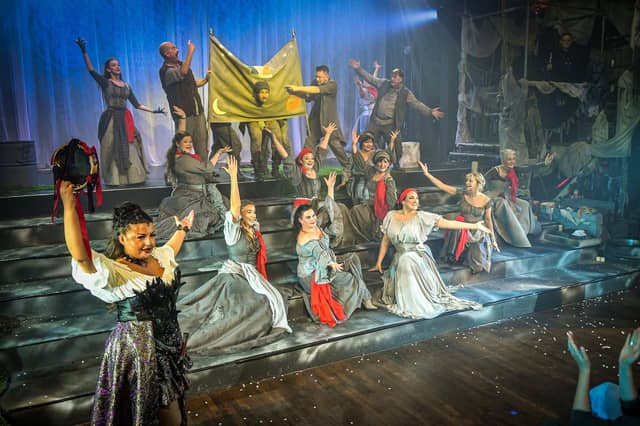

Burnley Light Opera Society have returned to The Mechanics Theatre with The Hunchback of Notre Dame, playing until Saturday, November 15, and this, genuinely, is amateur theatre in name only.
Now: important clarification for anyone expecting a singing goat and a bright turquoise gargoyle. This is not the Disney Sunday-afternoon-with-a-Cup-a-Soup version. Yes the music and lyrics are very much the same, alas this version leans right back into Victor Hugo. It’s dark and complex and grown-up. The stuff of stained glass windows and sin, not crayons and popcorn.
It all begins with Dom Claude Frollo. Gareth Andrew Smith plays him, and goodness me, the man is extraordinary. It’s one of those performances where he seems carved out of the same stone as the cathedral. His presence dominates the space before he’s even opened his mouth – and when he does open his mouth, his voice practically parts your fringe. Cold, righteous, full of fury and fear and something he’d rather not name. Chilling, because he believes he’s holy.
And then we meet his secret shame: the hunchback himself. Matt McGoldrick’s Quasimodo. And honestly, it’s one of those moments where you think, “oh, we’re in proper theatre territory here.” He appears….. bent, awkward, wary, and then comes that voice! Vocally bold, but emotionally so delicate, as if he’s holding his own heart in both hands and knows that if he squeezes it just a fraction too tight, he’ll break it.
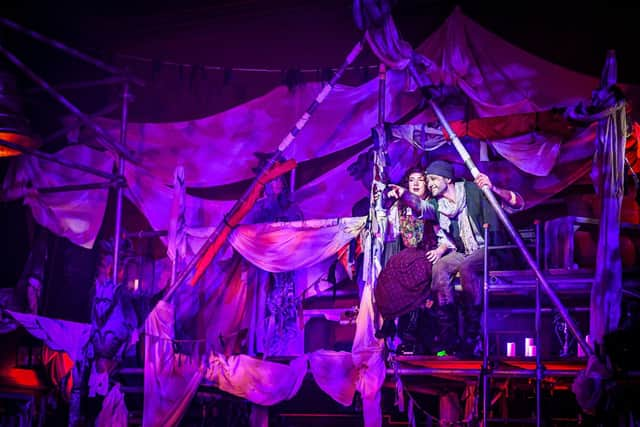
You believe him immediately. Mrs S believed him. The audience leaned forward in a very particular way, you know that slight tilt people do when they’ve forgotten about their sweets and they’re simply watching. It wasn’t pity, it was empathy.
Within seconds you felt protective of him, you wanted to lift him up, brush the dust off his sleeves and tell him he deserved better than the tower and those bells. And when the bells did ring, the way he reacted to them felt like muscle memory, like the sound had been living inside his bones for years. That’s craft, that is. That’s the kind of performance where someone hasn’t just learned lines, they’ve inhabited a life.
Into Paris arrives the Roma community, and right at the centre of them is Esmeralda. Scarlet Dickinson doesn’t just play Esmeralda, she seems to materialise from pure instinct and heartbeat. She enters and you feel the air shift. She brings colour, yes, and heat, certainly, but she also brings something far rarer: that sense of danger wrapped in absolute integrity. She’s free because she refuses to belong to anyone but herself. It’s all in the eyes, and it’s most definitely in the voice.
There’s fire in Scarlet’s Esmeralda – proper, righteous fire – but there’s just as much tenderness, just as much gentleness. There are shadows in her too, the kind people carry when they’ve had to learn to survive by reading the room before they speak. When she sings, it’s not “a song”, it’s a truth being told directly to you, and you find yourself believing her without question, even when she’s saying the thing no one wants to hear.
And of course within a few heartbeats the men start orbiting her, not because she flirts, but because she radiates a kind of self-possession they can’t quite handle. Captain Phoebus, played by Michael Bains with noble weariness, is drawn in almost despite himself, like a moth trying to pretend it’s choosing not to fly towards the candle.
Meanwhile Leonie Picariello’s Clopin has enough wit and political sharpness to run a country (and probably make it more fun). And the gargoyles, Graham Cheshire, Vicki Clarkson, Joanne Gill and Peter Rigney – hover around like the intrusive thoughts you have on the bus home. They say the thing you’re trying not to think, and they say it with such conviction you almost want to applaud the honesty, even when it stings.
Now to the staging. We really must speak about it, because it’s quite something. Director and choreographer Anthony Williams doesn’t do “safe middle ground”. He goes all-in, and thank goodness he does. It’s clever, theatrical, assured, and full of those little choices you only notice when you’re sat there thinking, “oh, they really thought about this, didn’t they?”
It’s not just good. It’s properly brilliant.
And the lighting (Neil Dolman and Anthony Williams again) is the finishing touch that makes the whole thing feel like a cathedral in motion. Great shafts of holy light slicing through the space, little clouds of imagined dust caught in it, like something from a religious documentary with a serious narrator who whispers. You sit there and you almost expect a monk to shuffle past and tell you to hush.
Zoe Tompkins’ choreography for the Roma scenes is full of life and danger. You can almost smell the bonfire smoke.
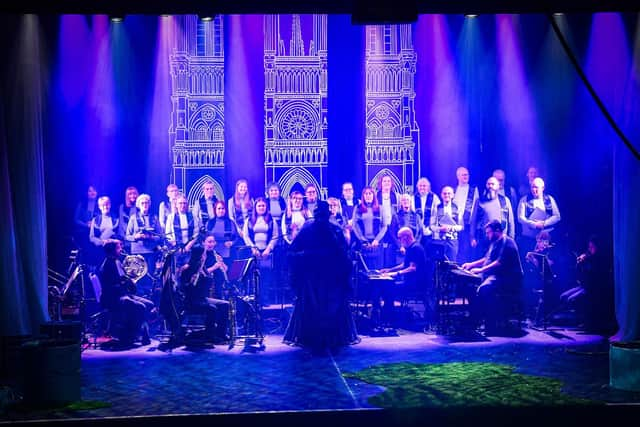
And the music. Steven Mercer-Murray conducts an orchestra that plays like they’ve got the keys to the West End pit. And that choir! 25 strong and absolutely glorious. When they hit those full-voiced harmonies, Mrs S actually inhaled sharply in a way that told me she was either overcome or having the beginning of a heart flutter.
In the end, what I loved most about this show was its honesty. It isn’t embarrassed by being bold. It isn’t shy of ambition. And it doesn’t apologise for wanting to move you and make you think.
The Hunchback of Notre Dame runs at The Mechanics Theatre, Burnley until Saturday 15th November.
Go. Honestly. If all amateur theatre was like this, the professionals would have to up their game.
Thank you for having me back. What a treat.
Richard Sanderson